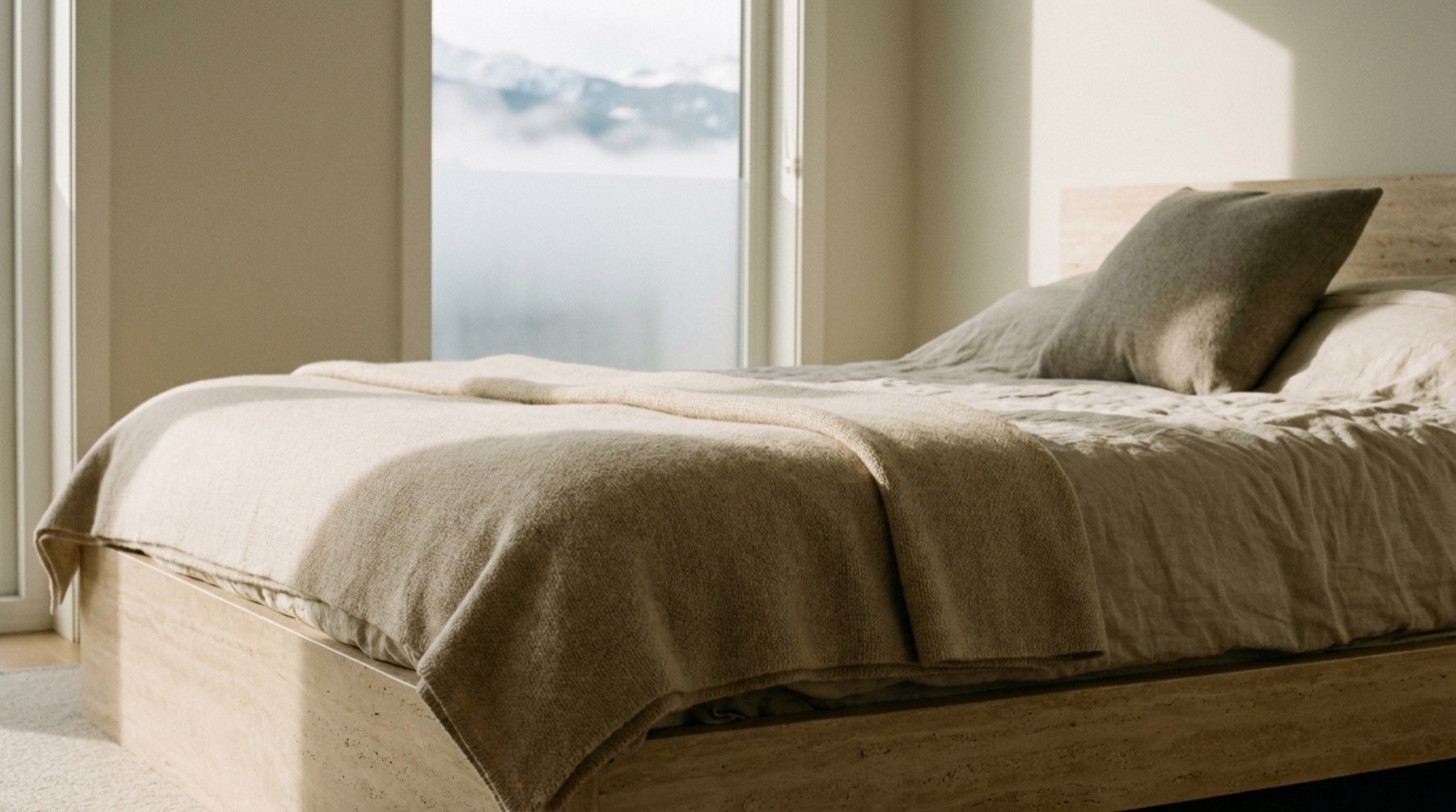
Temperature is the longevity variable hiding in plain sight. Comfort is what occupants notice; thermoregulation is what the cardiovascular and metabolic systems are doing in the background. The two correlate but diverge, the comfortable bedroom at 22 °C is the wrong bedroom for sleep architecture.
What temperature actually is, in a residence
Three frames matter:
- Air temperature, the variable on the thermostat and the one occupants set. Easy to measure, partial signal.
- Mean radiant temperature, the temperature of the surfaces the body sees. The dominant variable in actual thermal comfort.
- Humidity envelope, the variable that governs mucosal surface, microbiology, and the perception of warmth.
Together they determine whether the body is in a thermoneutral state, not regulating against the environment, or doing work to maintain core temperature.
The thresholds that matter
- Sleep zone, ambient: 16 to 19 °C for most adults under a duvet (Okamoto-Mizuno & Mizuno 2012).
- Waking living areas: 19 to 22 °C, depending on cultural and individual preference.
- Mean radiant temperature: should be within 2 °C of air temperature for comfort.
- Relative humidity: 40 to 50% target band. Below 30% or above 60% has measurable health consequence.
- Thermal bridges: surface temperature should not drop more than 3 °C below ambient anywhere in the envelope. Below that, condensation forms; mould follows.
Where the design decisions actually live
For most residential projects, the temperature outcome is set by four decisions:
Building envelope. Insulation specification, glazing performance, thermal-bridge geometry. Determines the gap between air temperature and mean radiant temperature, the rate of thermoregulatory heat loss in winter, and the over-temperature risk in summer.
Heating system topology. Radiant systems (underfloor, ceiling, wall) raise mean radiant temperature without creating convective currents. Radiator systems work by convection and produce thermal stratification (hot ceiling, cool ankle). Heat-pump compatibility favours radiant.
Cooling and humidity. Active cooling without dehumidification produces a damp envelope. Heat-recovery ventilation with humidity recovery (ERV) is the cleaner specification. In hot-humid climates, the latent load is the variable that matters; sensible cooling alone is insufficient.
Sleep-zone microclimate. The bedroom should be coolable to 16 to 19 °C independent of the rest of the house. In high-mass buildings without active cooling, this can be the hardest target to hit. Active mattress cooling is a workaround; the right answer is envelope and zoning at design.
What “temperature” looks like in a MAVI Blueprint
A residence’s Temperature score is built from envelope thermal modelling (insulation U-values, thermal-bridge analysis via thermography), surface-temperature measurement at the points the body occupies (bed, sofa, work surface, bathroom floor), humidity logging across seasons, and a control-system review (zoning by room, scheduling, response time).
The output is a 0 to 100 sub-score and a priority intervention list. For most residences, the highest-leverage interventions are sleep-zone microclimate control and humidity envelope.
The single thing to do today
Run a cheap data-logger (Govee, SwitchBot, similar) in the bedroom for a week. Plot temperature and humidity against the hour. Most people discover their bedroom is two to four degrees warmer than the thermoneutral target during sleep. The MAVI Blueprint does the building-envelope analysis and the intervention design.