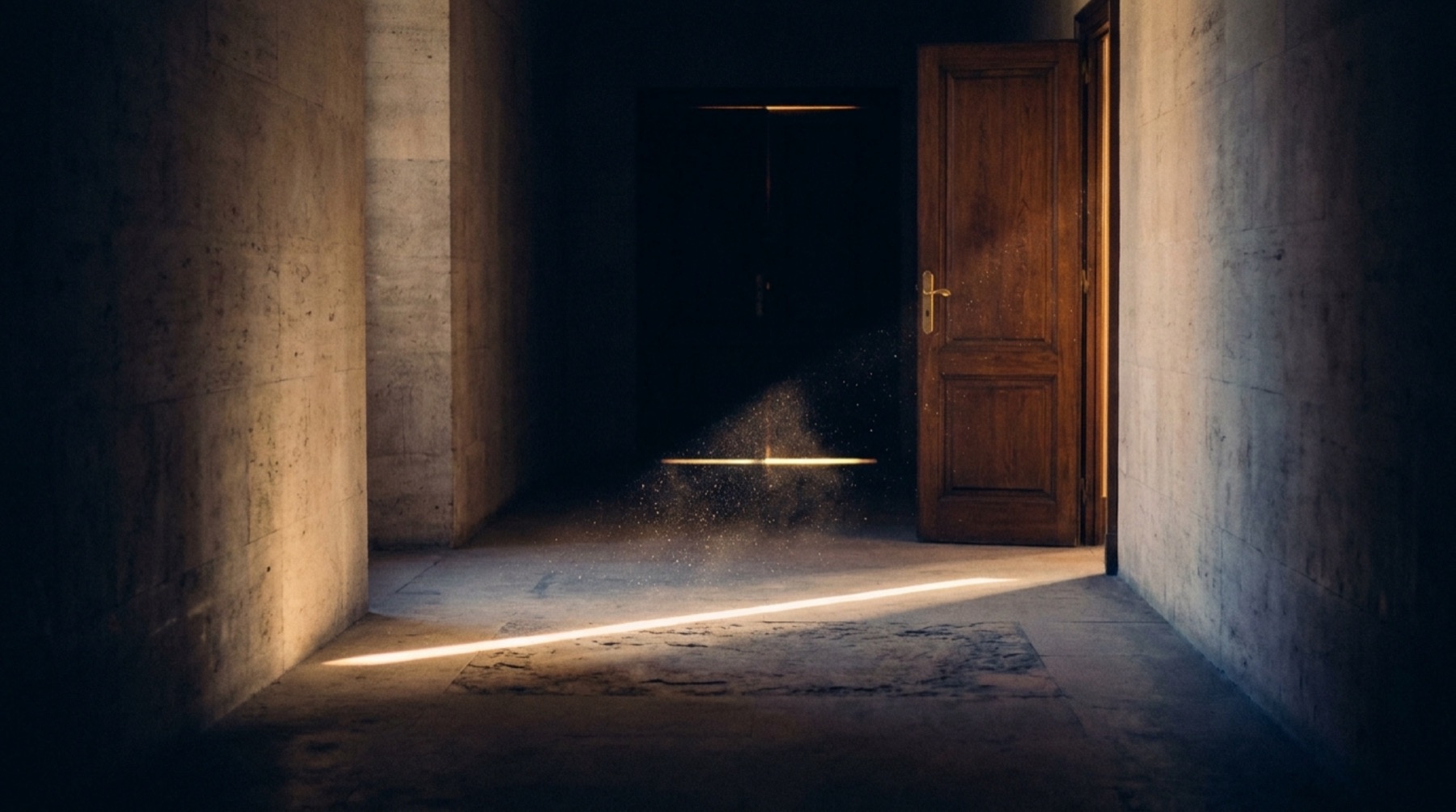
The single most consequential discovery in environmental health in the last twenty years is that light is a hormone. Not a metaphor; a direct, measurable input to the suprachiasmatic nucleus that sets cortisol, melatonin, body temperature, and the rest of the circadian cascade. The architectural implication is that lighting decisions are hormonal decisions.
What light actually is, in a residence
Three timescales matter:
- Daytime, when the eye should receive abundant high-melanopic light to anchor the morning cortisol peak and keep the circadian clock entrained. Daylight access, window orientation, glazing performance, and fixture specification all matter.
- Evening, when the eye should receive minimal melanopic load. The fixtures over the dining table, in the kitchen, and in the bedroom collectively determine the evening melatonin curve.
- Night, when the bedroom should be effectively dark. Even low-level (5 lux) overnight light measurably suppresses melatonin (Phillips et al. 2019).
Most homes get the daytime case right almost by accident (windows exist) and the evening and night cases wrong almost by default (every fixture, every standby LED, every street-light leak counts).
The thresholds that matter
- Daytime melanopic EDL: target above 250 lux at the eye for at least the first part of the working day (Brown et al. 2022).
- Evening melanopic EDL: target below 10 lux at the eye in the hour before sleep.
- Sleeping bedroom: target below 1 lux measurable at the pillow. Standby LEDs alone often exceed this.
- Light at the eye, not at the floor: the unit that matters is what the retina sees, not what the lux meter reads on the desk.
- Spectrum: warmer than 2700K in the evening; broader-spectrum and cooler during the day.
The MAVI 129 Light domain measures melanopic EDL, blackout integrity, fixture spectrum by room, dawn-simulation viability, glare index, and flicker.
Where the design decisions actually live
For most residential projects, the light outcome is set by four decisions:
Daylight access. Window orientation, sill height, glazing transmittance, internal layout, and the relationship between sleeping zones and east-facing apertures. East-facing bedrooms with the curtain fit-out specified at design stage cost almost nothing; retrofitting daylight in is impossible.
Evening fixture specification. Warm spectrum (under 2700K), dimmable, indirect placement (washing the wall and ceiling, not pointing at the eye), and zoned by hour. The current fashion for cool-white feature lighting at dinner is a circadian disaster.
Blackout integrity. Window blackout fit, no standby LEDs in the sleeping bedroom (or covered with electrical tape), no light leakage under doors, blackout against external light pollution. The bedroom should be effectively dark.
Dawn simulation. Where natural east-light is unavailable, dawn-simulation lighting at the fixture level (not a bedside lamp) provides the cortisol-awakening signal. Specifies once, runs forever.
What “light” looks like in a MAVI Blueprint
A residence’s Light score is built from a daylight study (orientation, hour-by-hour solar access by room), spectroradiometer measurement of evening fixtures (melanopic EDL, spectrum, dimming linearity), blackout audit (each window, each device, each door gap), glare and flicker measurement, and a control-system review (zoning, dimming, dawn simulation).
The output is a 0 to 100 sub-score and a priority intervention list. For most residences, the highest-leverage interventions are bedroom blackout integrity and evening fixture specification.
The single thing to do today
Walk through the house at the times of day that matter, first hour after waking, the hour before sleep, in the middle of the night. Look at what light is reaching the eye. The MAVI Snapshot does the daylight-access modelling automatically; the Blueprint does the per-fixture spectroradiometer work.