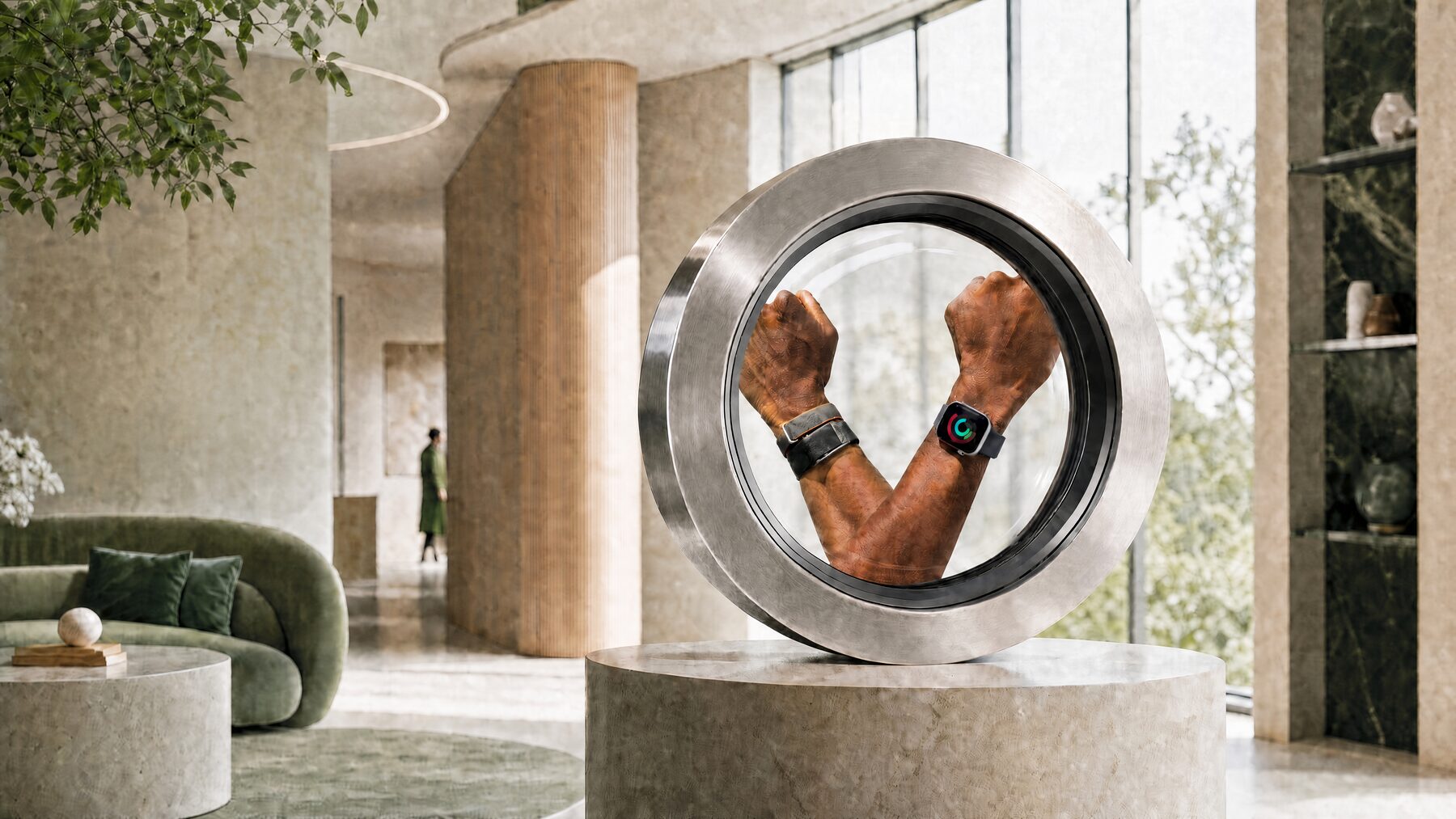
Marques Brownlee spent almost two weeks wearing a Whoop, a Fitbit Air and an Apple Watch at the same time to answer one question for his teammates: is the cheaper screenless tracker as good as the expensive one. His video, The Truth About the "Whoop Killer", is a careful and honest review. The Fitbit Air works with no subscription and tracks heart rate, steps, calories and sleep. The Whoop is free hardware that becomes a brick the moment you stop paying its membership, which runs from about 200 to 350 dollars a year.
Underneath the comparison sits a larger fact that no wearable review ever states. Every one of these devices measures the same thing: the body's outputs. None of them measures the input that produces those outputs. The room.
The wrist is an output meter
A wearable reads heart rate, heart-rate variability, sleep stages, skin temperature and a recovery score. It is brilliant at this. But a low recovery score tells you the night went badly. It cannot tell you why. The why is almost always environmental: the bedroom held its heat, CO₂ climbed past 1000 ppm by the early hours, a streetlight leaked past the blind, the air carried particulate that never cleared. The wrist records the consequence with four decimal places. It is blind to the cause.

The largest variable is the one nobody wears
You can change the wearable and the data barely moves, because the device was never the variable. The variable is the 160 hours a week spent indoors. A tracker on a wrist in a bedroom at 24°C with stale air will report poor recovery no matter how much it cost. Swap it for a cheaper one and you measure the same bad night for less money. So the honest answer to "which tracker" is the one the review cannot give: the tracker is rarely the thing holding your recovery back. The room is.
A subscription for the symptom
Look at the model the review describes. The value is locked behind a recurring fee, forever. You are paying, every month, to be told the score of a night your home already decided. MAVI inverts the order. We measure and specify the input once, so the output improves on its own, every night, with nothing on your wrist required to flag it. Health is built before willpower arrives, and before the subscription does.

MAVI completes the wearable, it does not replace it
This is not an argument against wearables. The MAVI Diagnostic integrates them directly: Ōura, Whoop, Apple Health, Eight Sleep. The wearable supplies the biological output. MAVI supplies the environmental input across ten domains and 129 measurable factors. The Biological Performance Overlay maps one against the other, so you can finally see which room produced which night. Two halves of a single dataset that, until now, were never read together.
The single sentence
Your wearable measures the body. MAVI measures the room the body is in.
Keep the tracker. Then measure the half of the data it was never able to see. The free Snapshot reads any address across eight live data sources. The Diagnostic reads all ten domains and the full 129. The methodology is published, and every number in it is cited.
This essay responds to The Truth About the "Whoop Killer" by Marques Brownlee, read through the MAVI lens. Generate a free Snapshot of your home.