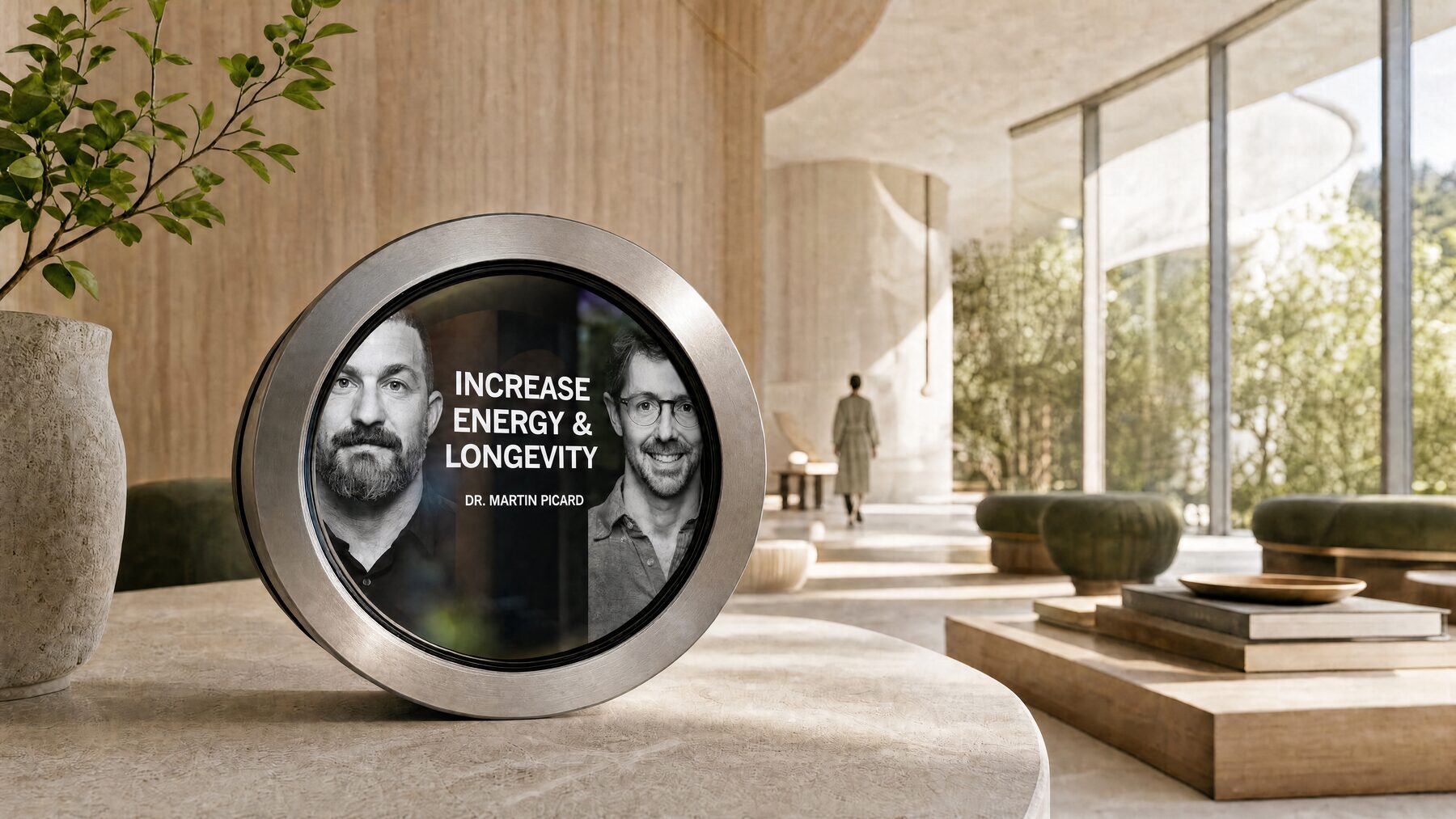
On the Huberman Lab podcast, Martin Picard makes a quiet but radical claim. Mitochondria do not simply make energy. They are information processors. They take in everything you do, think and experience, and translate it into the energy you feel as vitality or fatigue. How fast you age is, in large part, the running total of the energetic load your life places on them. And the share of that outcome you actually control is far larger than most people assume.
Mitochondria translate, they do not just power
The textbook line is that mitochondria are batteries. Picard's work reframes them as something closer to an interpreter. They sit at the junction between your life and your biology, converting signals, a stressful call, a poor night, a sense of purpose or its absence, into ATP, heat and the molecular messages that set how the rest of the body behaves. When the demand placed on the system chronically outruns the energy available to meet it, the organelles are ground down. He has a name for that mismatch, allostatic load, and a marker that tracks it, GDF-15, which climbs with ageing and with the diseases of energetic exhaustion.
He also introduces the idea of a "mitotype": individuals and even individual organs carry distinct mitochondrial profiles, and they can age at different rates. Your heart and your brain are not on the same clock, and the clock speed is set, in part, by how much energy each tissue has had to spend defending itself.
The most freeing number in the conversation is the split between what you inherit and what you set. Only a small fraction of longevity is written in the genes. The overwhelming majority is authored by behaviour and environment, which means the lever is almost entirely in your hands, and in your rooms.
The load you can feel
Picard's research treats the environment as a direct input to the cell, and he is unusually willing to count the soft inputs. Monotony has an energetic cost. So does subordination, isolation, and a life without meaning. Your state of mind is not separate from your metabolism. It shows up as the bill.
The most striking demonstration is hair. In work he has been involved with, greying tracks periods of psychological stress on a timeline, and in some cases reverses when the stress lifts. A grey hair is a visible read-out of an invisible energy ledger: the body, under load, diverting resources away from a "luxury" like pigment. It is a reminder that the cell is constantly deciding what it can afford, and that those decisions are driven by the total demand placed on it.
Capacity falls as cumulative load accrues. A lower environmental tax keeps the curve higher for longer. Directional.
The load nobody counts
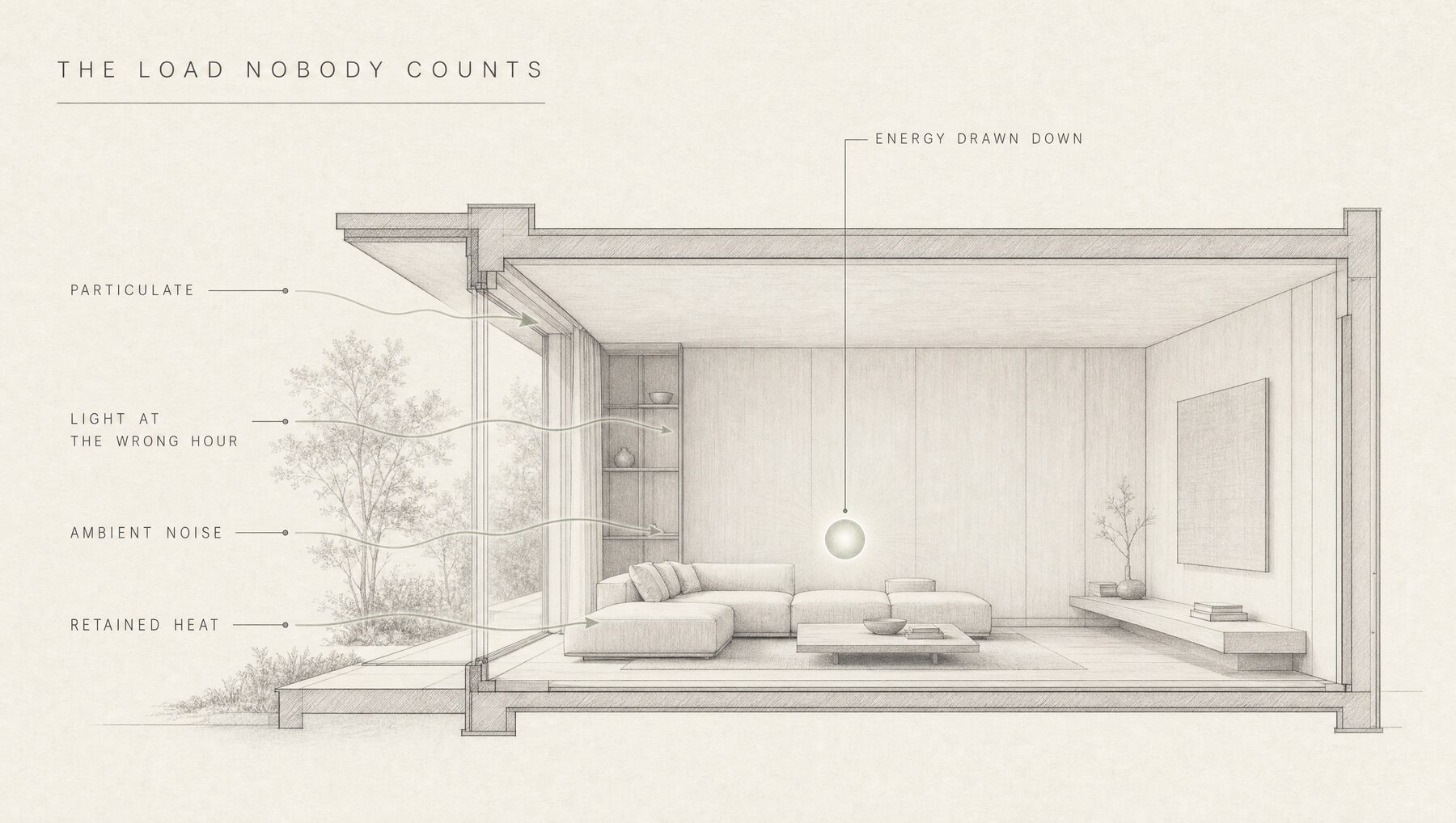
There is one input Picard's frame implies but never names: the physical room. The cell does not distinguish between a stressful relationship and a stressful room. Both are load. Air thick with particulate the body has to neutralise. Light at the wrong hour forcing the system to fight its own clock. A bedroom that holds its heat so sleep never deepens and the nightly recharge never completes. Noise that keeps the nervous system half-braced. These are not occasional demands. They are a continuous tax, levied for the roughly one hundred and sixty hours a week spent indoors, paid in mitochondrial energy.
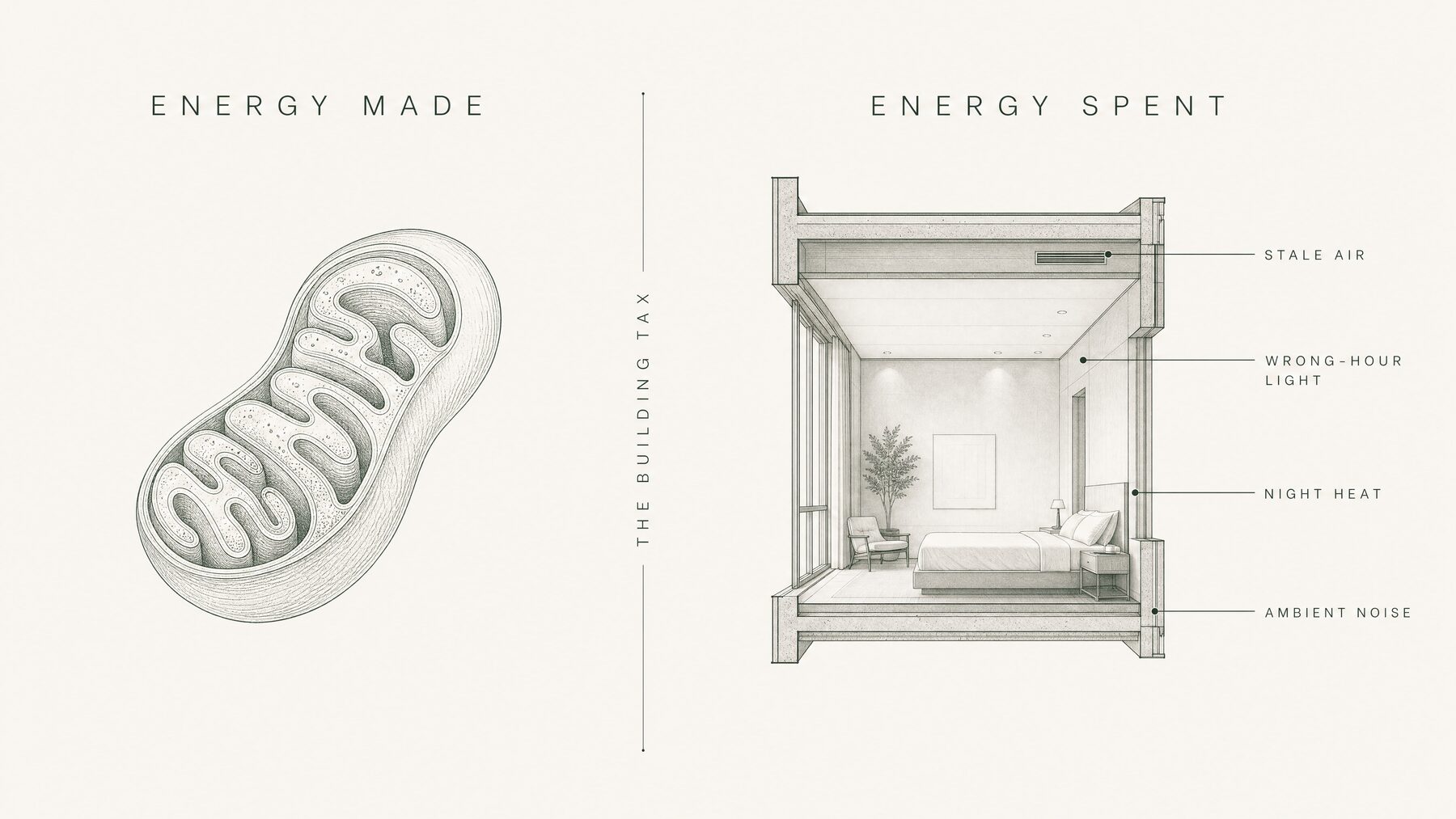
If meaning and monotony pattern your cells, so does the literal space you sit in. The difference is that the room can be specified, and the relationship and the meaning cannot be engineered with a filter and a lighting schedule.
The building's ledger
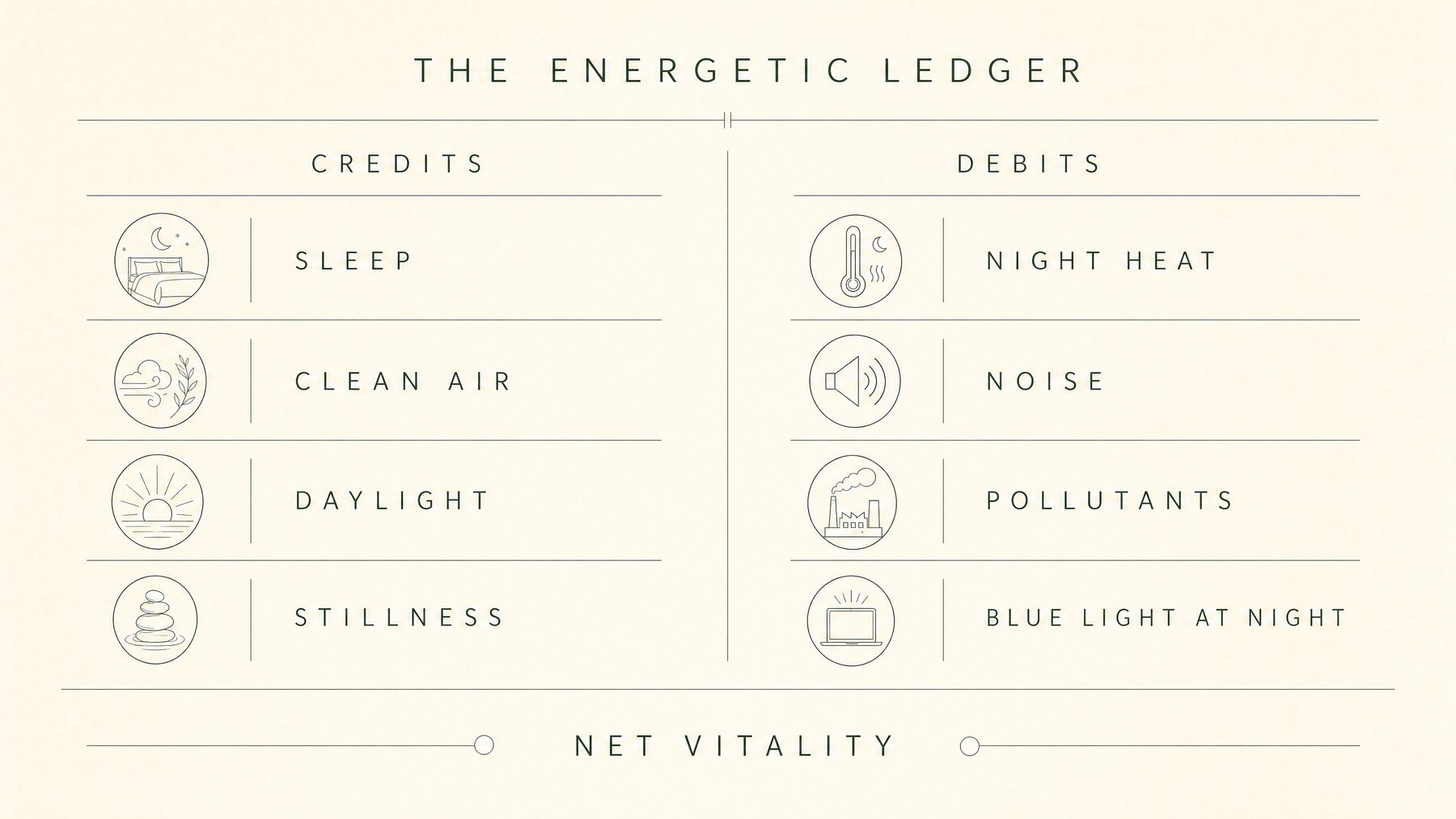
Read as a ledger, a home has two columns. On one side, the credits: deep sleep in a cool dark room, clean filtered air, daylight at the right hour, acoustic calm. On the other, the debits: night heat, ambient noise, pollutants, blue light after dark. Most homes run a quiet deficit, and the body covers the shortfall out of the same energy account you would rather spend on thinking, training, recovering and living. The deficit is invisible precisely because the body is so good at covering it, until, years in, it cannot.
Lower the building's tax
MAVI reads a home across ten domains and one hundred and twenty-nine measurable factors, then specifies the air, temperature, light and sound so the building stops charging you to be in it. Exercise, sleep and meaning all raise mitochondrial supply; a well-specified room lowers the demand. Picard's prescription and ours are not in competition. They are the two sides of the same ledger. The aim is simple: spend the day in a room that adds to your energy rather than drawing it down.
What to do now
Move the ledger back into surplus. Cut the debits, bank the credits:
- Temperature
- 16 to 19 °C
- Air
- PM2.5 < 5 µg/m³
- Air (CO₂)
- < 800 ppm overnight
- Light
- < 2700K in the evening
- Measure it. A free MAVI Snapshot shows where the home is spending your energy; the Diagnostic scores all ten domains.
- Cool and quiet the bedroom. Around 16 to 19°C and a night-time acoustic floor under about 30 dBA, so sleep, your largest nightly recharge, actually deepens.
- Clean the air. PM2.5 under 5 µg/m³ and overnight CO₂ under about 800 ppm with MERV-13 filtration. Stale, particulate air is a tax paid in repair.
- Fix the light timing. Bright daylight in the morning, warm light under about 2700K and dim in the evening, so the circadian system is not burning energy fighting the clock.
- Lower the chemical load. Low-VOC materials, so the air itself is not a constant small demand.
Exercise, sleep and purpose raise the energy you make. A well-specified room lowers the energy the building takes. You want both sides of the ledger.
The single sentence
Picard counts the energy your life costs your cells. MAVI removes the cost the building was adding for free.
This essay responds to Dr. Martin Picard on the Huberman Lab podcast, read through the MAVI lens. Generate a free Snapshot of your home.