
Bryan Johnson has the most documented body in the public longevity field. His video You're Exercising Wrong is also one of the clearest pieces of longevity thinking to reach a mass audience this year. Its argument is simple and correct. The body is not one system. It is many systems working together, and the question is not which single form of exercise is best. The question is which combination keeps you alive the longest.
It names five. Strength. Low-intensity cardio. High-intensity cardio. Mobility. Balance. Each is defended with a number. Regular exercise lowers all-cause mortality by around 31%. The weakest third of a million Swedish men carried a 20 to 35% higher risk of early death than the strongest. Every one-point gain in VO2 max is associated with roughly 45 extra days of life. Adults who cannot stand on one leg for ten seconds carry an 84% higher mortality risk. The case is made well, and it is made with citations, which is the only way a longevity claim should ever be made.
Then it gives the protocol a price in time. Six to eight hours a week.
That number is where architecture begins.
The other one hundred and sixty hours
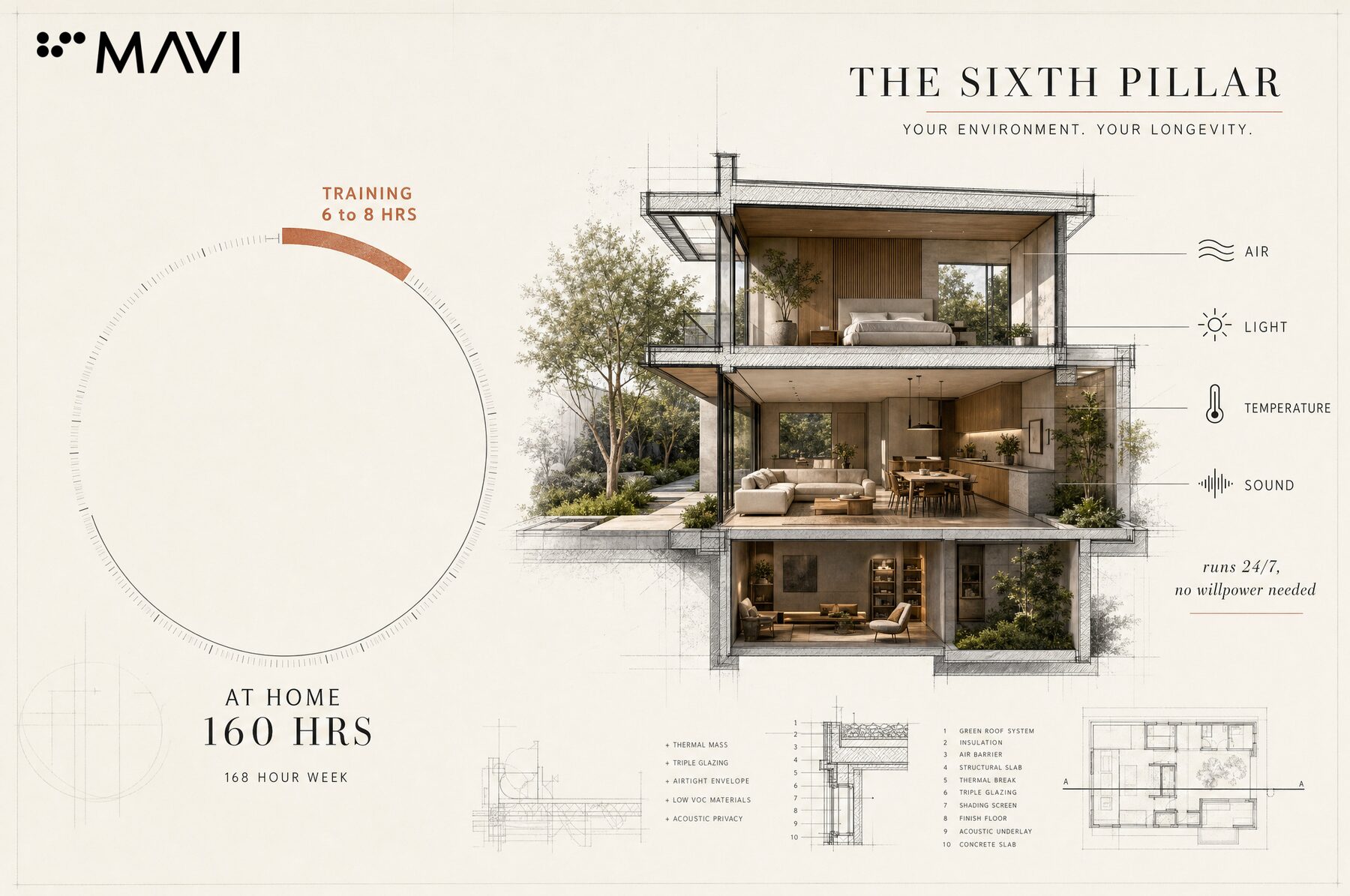
There are 168 hours in a week. The five pillars, practised to the letter, account for six to eight of them. The remaining 160 are spent somewhere, and for most people most of that time is spent indoors, in one building. People spend more than ninety percent of their lives inside. The body those five pillars build does its recovering, its sleeping, its breathing, and its repairing inside a structure that almost nobody has specified for the job.
This is the same mistake the video warns against, made one level up. Ignore one system and the others suffer. The five pillars are five systems inside the body. The building is the sixth, and it is the one that runs continuously, without motivation, while you sleep.
Call it the sixth pillar. It is the one the exercise frameworks forget.
A pillar you do not have to attend
The five pillars share a weakness the video is honest about. The hardest part is not intensity. It is consistency. The single line that matters most in the whole protocol is the quiet one near the end: you do not need the perfect routine, you need to start, and then you need to keep going. Every pillar costs willpower, and willpower is the input most likely to fail.
A building does not have this problem. It performs every night whether you are disciplined or not. Air, light, temperature, and sound act on the body for the full 160 hours at no cost in motivation. This is the whole of the MAVI thesis in one sentence. Health is built before willpower arrives.
So the sixth pillar is not a sixth thing to do. It is the one pillar that, once specified, keeps working while you sleep.
The five pillars, read through the walls
Each exercise pillar has an architectural counterpart that either completes it or undoes it.
Strength is made in the bedroom, not the gym. The set happens under the bar. The adaptation happens hours later, during sleep, when the body repairs what the session damaged. A bedroom that leaks light, holds CO₂ above 1000 ppm, sits too warm, or carries a nocturnal sound floor above 30 dB(A) blunts that repair every night. The strongest training week in the world is reverted by degrees in a bedroom that will not let the body recover.
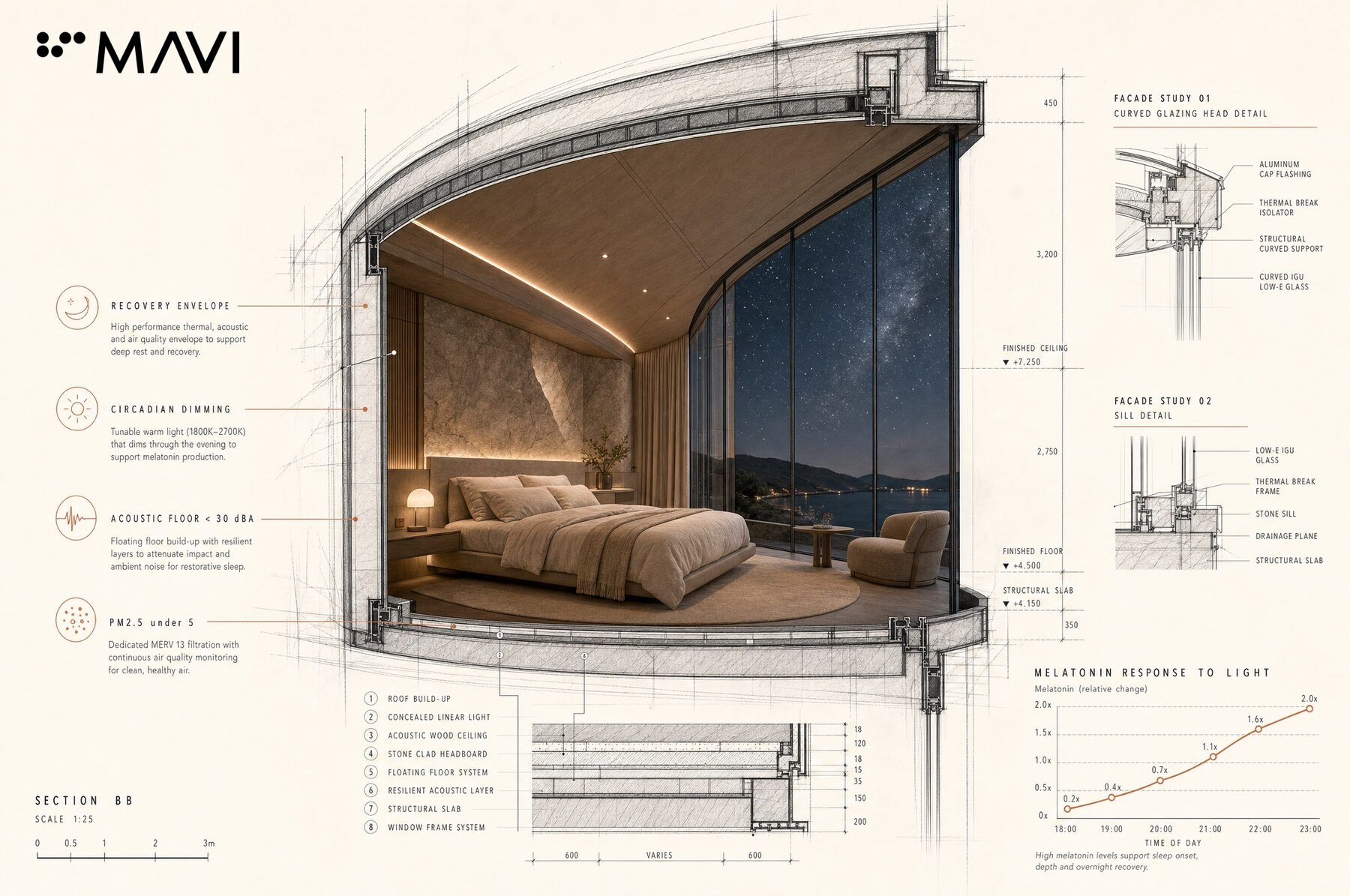
Zone 2 builds the mitochondria. The air decides what they breathe. Low-intensity cardio trains the body's power plants to produce energy cleanly. Those same power plants then spend 160 hours metabolising whatever is in the indoor air: combustion particulate from a gas hob, off-gassing from new furniture, fine particulate that never cleared. You cannot train a system in the morning and degrade its substrate for the rest of the day and call it optimised.
You cannot out-train a bedroom that never lets the nervous system stand down. High-intensity work raises VO2 max, the strongest single predictor of longevity the video names. But cardiovascular load is not set only in the gym. A home that holds the body in low-grade alertness all night, through noise, heat, or poor air, raises the resting baseline the heart works against. The architecture is either lowering that floor or raising it.
Mobility is written into the floor plan. The video is right that daily movement protects the ability to move. Most of that movement is incidental: stairs, distance, the pull of natural light drawing the body toward a window or a door. A home optimised purely for convenience removes the very friction that keeps a body mobile. The floor plan is a movement protocol, authored on purpose or by accident.
Balance is a brain measurement, and the brain runs on rhythm. The one-leg test is a proxy for neurological health, and neurological health is downstream of sleep and circadian alignment. A home that delivers bright, melanopic-rich light to the eye in the morning and near-darkness at night is feeding the same system the balance test reads. Light is not décor. It is the clock the brain sets itself by.
The same discipline, applied to the room
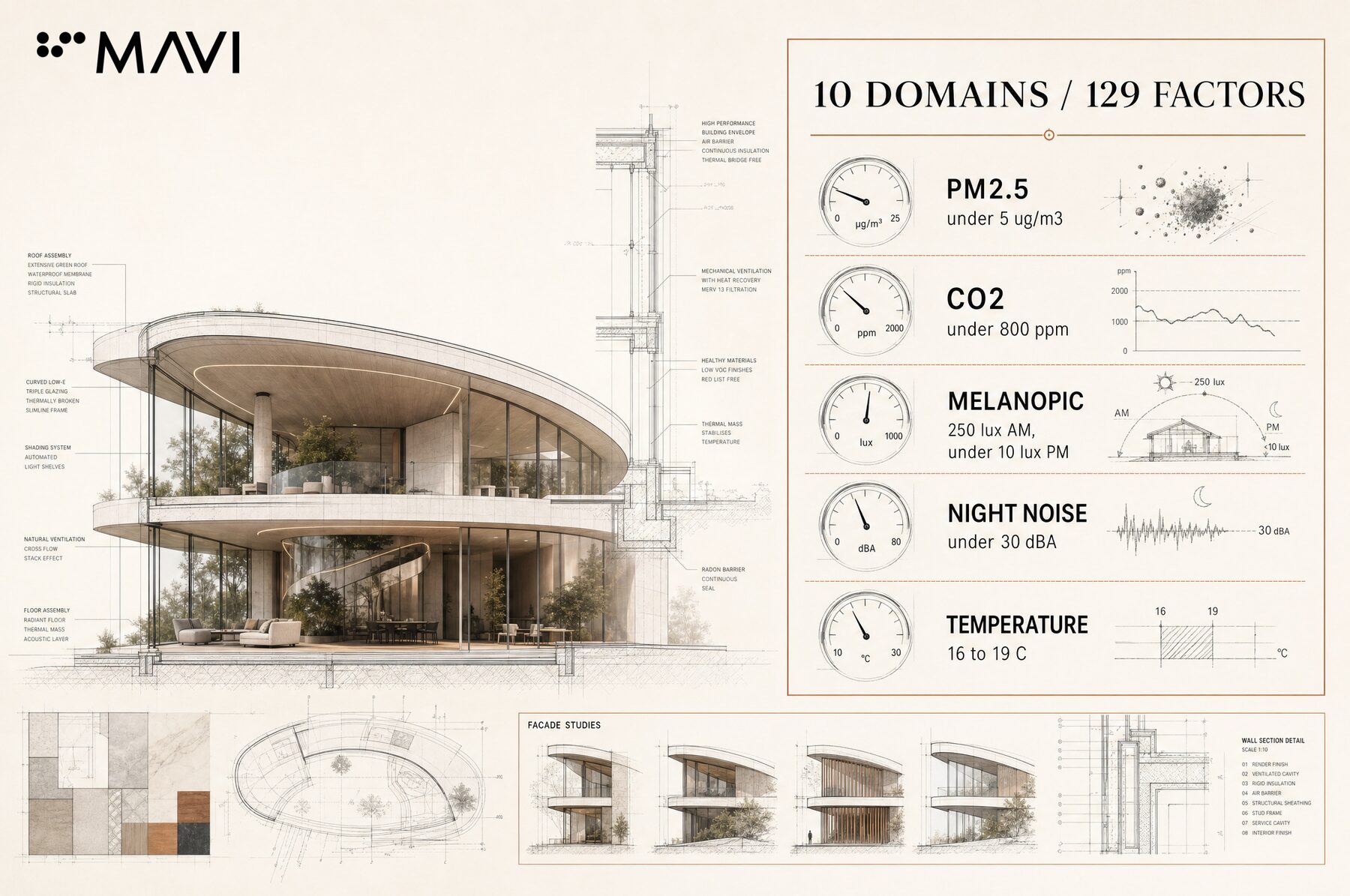
What makes the video trustworthy is that it measures. Heart rate zones. VO2 max. The talk test. A number for every claim. MAVI applies exactly that discipline to the building. Ten interconnected domains. One hundred and twenty-nine measurable factors. PM2.5 below 5 µg/m³ overnight. CO₂ below 800 ppm in the room you sleep in. Melanopic light above 250 lux at the eye in the first hour awake, and below 10 lux in the last hour before sleep. A nocturnal sound floor below 30 dB(A). No anecdotes, no folklore. Every factor sourced.
The body half of longevity has been written to four decimal places. The architecture half, for almost everyone, has been authored by accident.
We have made this case before about the rooms themselves, in the house Bryan Johnson's biology lives in. That essay specified the property. This one specifies the protocol. They are the same argument seen from two ends.
The single sentence
The five pillars build the body. The sixth pillar is the building it lives in.
You can run the cleanest protocol ever designed for six hours a week. For the other one hundred and sixty, the home is either finishing the work or undoing it. There is no third option, and there is no day off.
We measure which one it is. The free Snapshot reads any address across eight live data sources. The Diagnostic reads all ten domains and the full 129. The methodology is published, and every number in it is cited, in the same spirit as the video that prompted this essay.
Train all five pillars. Then specify the sixth.
This essay responds to You're Exercising Wrong by Bryan Johnson, read through the MAVI lens. Generate a free Snapshot of your home.