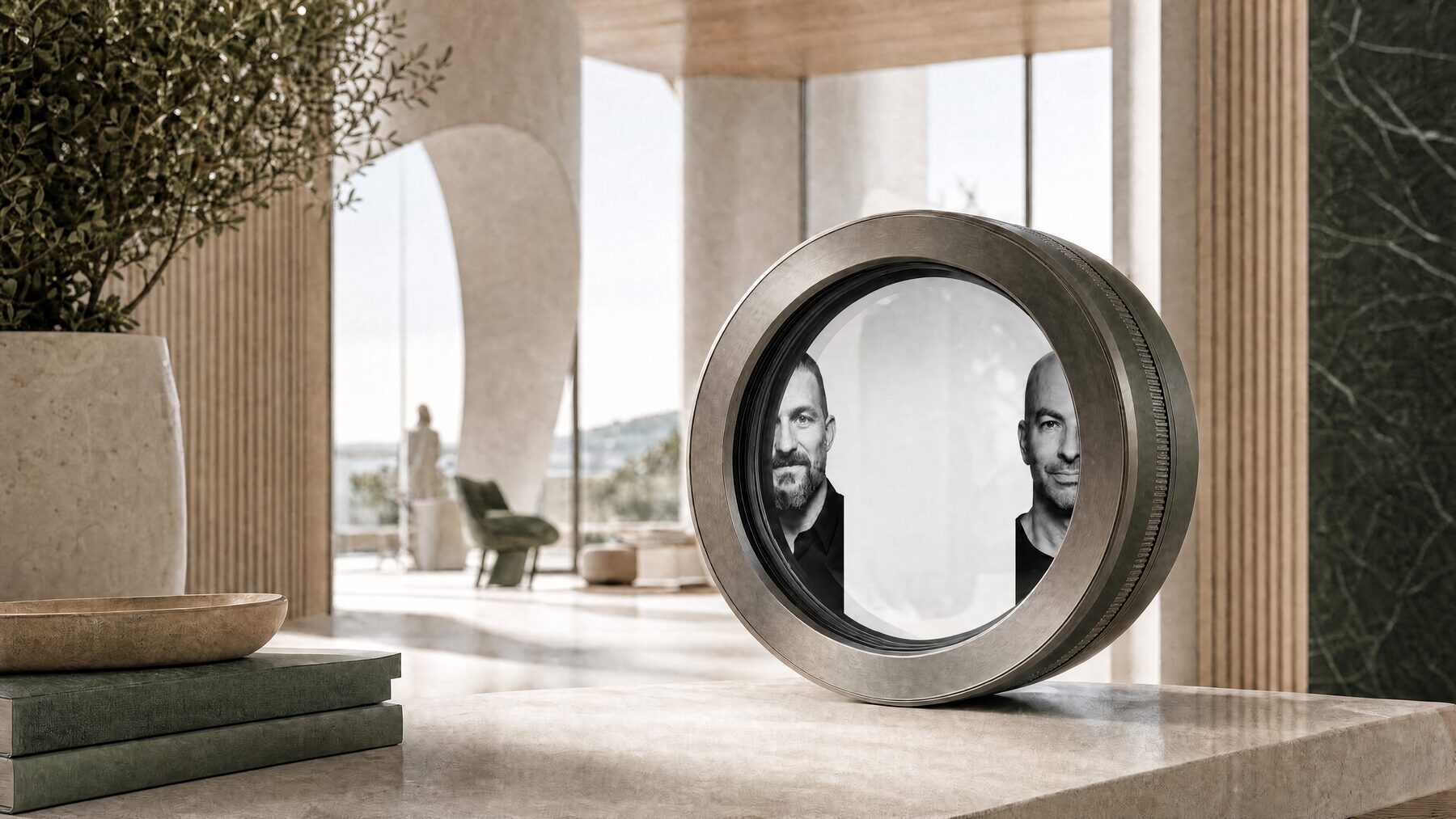
In his exchanges with Andrew Huberman, Peter Attia is blunt about priorities. Before anyone debates a supplement or a macro, they should have their exercise house in order, because exercise is the most powerful longevity lever that exists. The evidence he points to is some of the most dramatic in all of medicine, and it is about the few hours a week you spend training. What almost no one talks about is the other twenty-three hours, when the actual adaptation is won or lost.
The strongest lever there is
The headline is cardiorespiratory fitness, measured as VO2 max. Across the range of fitness, all-cause mortality does not vary by a few percent. It varies by something close to fourfold between the least fit and the elite of the same age, and the very fittest carry a small fraction of the risk of the least fit. Strength tells a similar story: low muscle mass and low grip strength both carry substantial hazard. Attia's point is one of sequencing. Fix the largest variable first. Everything else is rounding.
Train for the life you want last
Attia frames the whole programme around what he calls the Centenarian Decathlon, or the Marginal Decade: the set of physical tasks you want to still be able to do in the final ten years of life, reverse-engineered into training today. Lifting a grandchild. Carrying bags up stairs. Getting off the floor unaided. He builds backward from that, across four domains: stability, strength, aerobic efficiency, and peak anaerobic capacity. It is rigorous, specific, and entirely about what you do inside the gym.
The unstated assumption is that the training stimulus becomes fitness on its own. It does not. It becomes fitness only if the body is given the conditions to adapt, and those conditions are set somewhere else entirely.
Where the adaptation actually lands
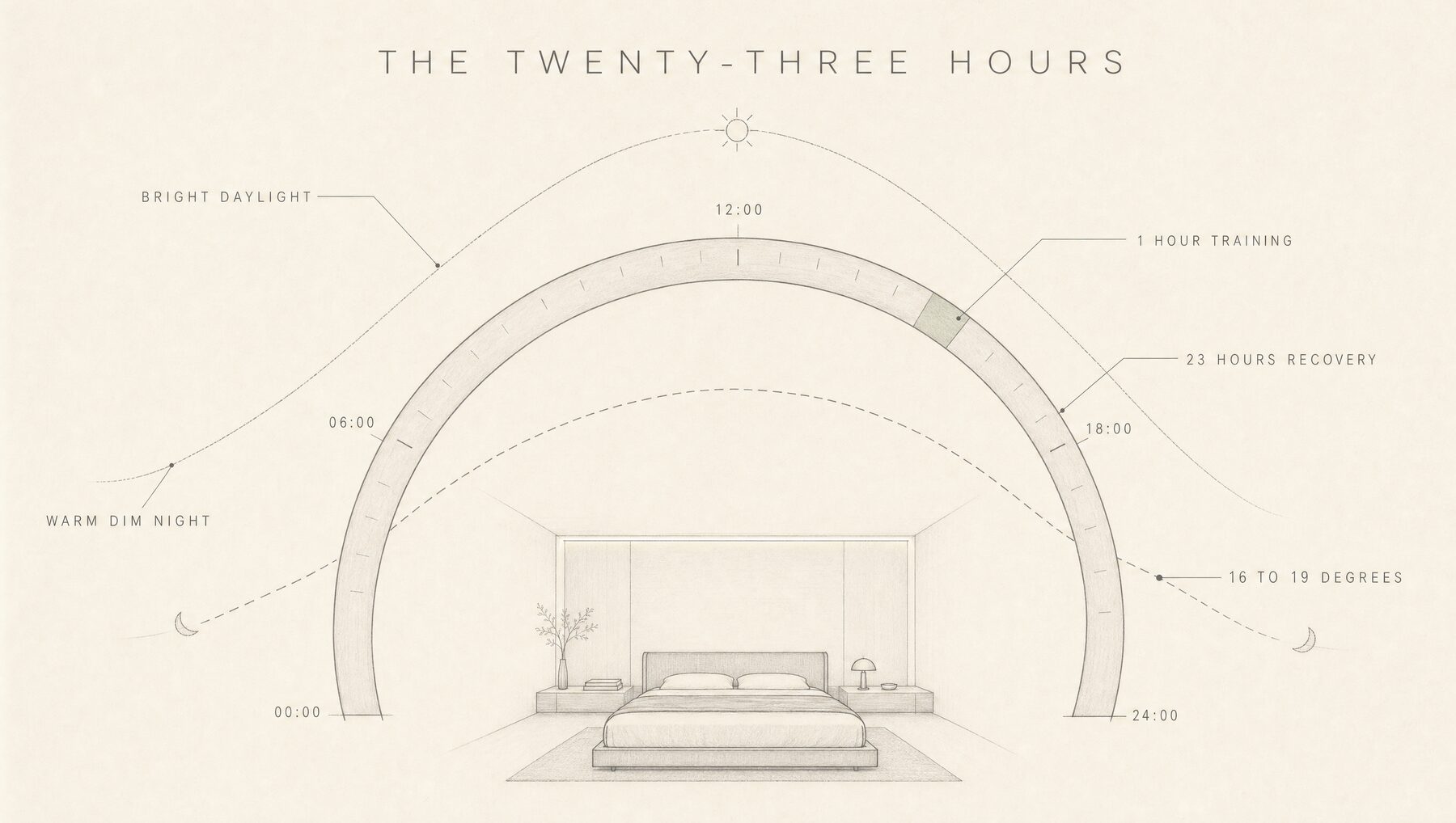
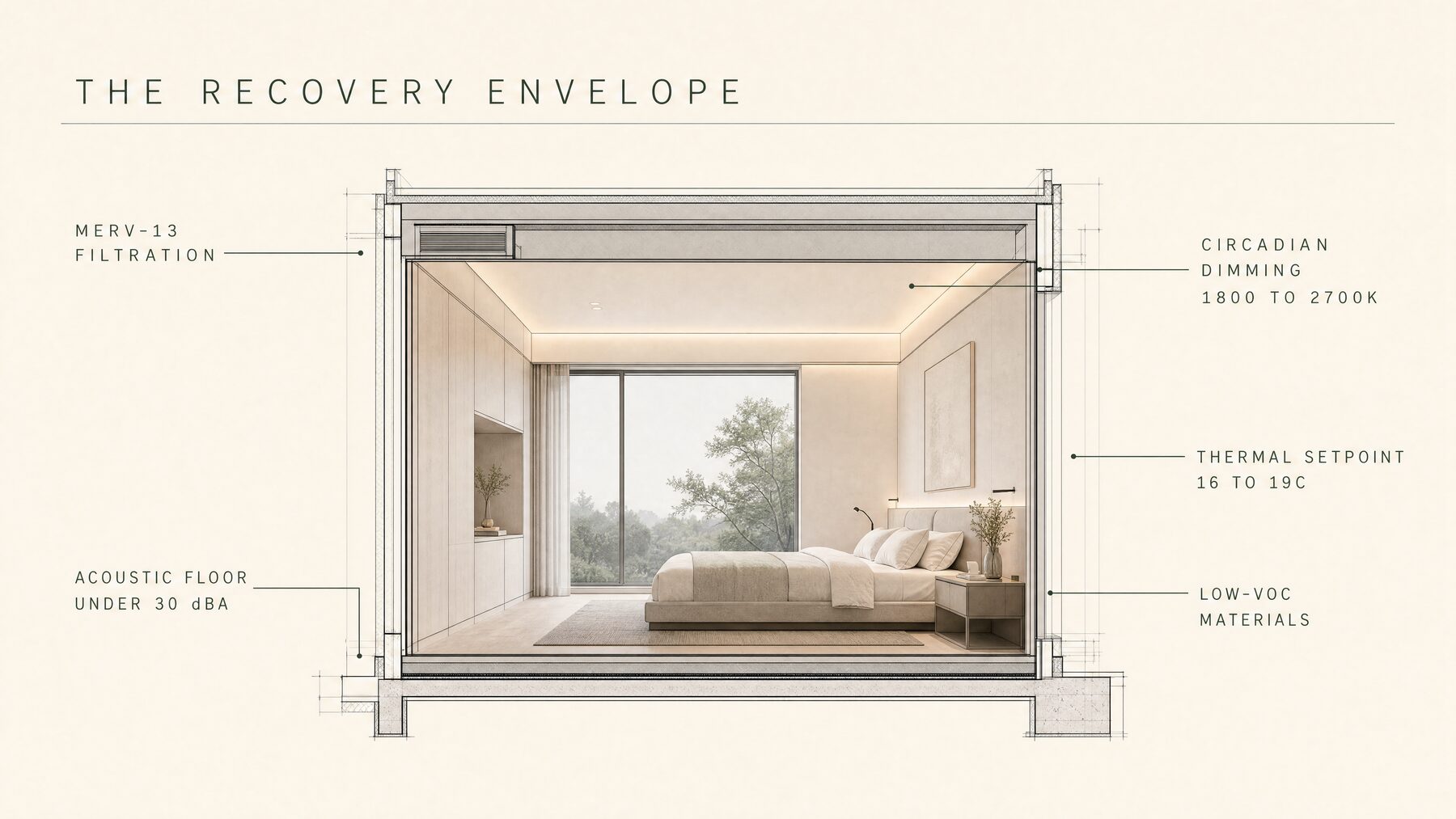
The session is the stimulus. It is the provocation, the stress, the signal. The adaptation, the part that becomes fitness, happens afterwards, while you sleep, breathe and recover. An hour a day in the gym writes the cheque. The other twenty-three hours decide whether it clears. Muscle protein synthesis, cardiovascular remodelling, the hormonal repair that follows hard training: all of it is scheduled for the hours you are not training, and most of those hours are spent inside one building.
The twenty-three hours
And the room decides their quality. If the bedroom runs warm and stale, deep sleep shortens and the training adaptation never fully consolidates, growth hormone and testosterone release blunt, the nervous system never fully stands down. If the air carries particulate, every recovery breath is doing extra work and low-grade inflammation competes with repair. If light hits the eyes at the wrong hour, the melatonin rise that gates overnight recovery is suppressed. You can hold a flawless VO2 max protocol and hand its gains back, every night, to a room that was never specified for recovery.
The recovery envelope
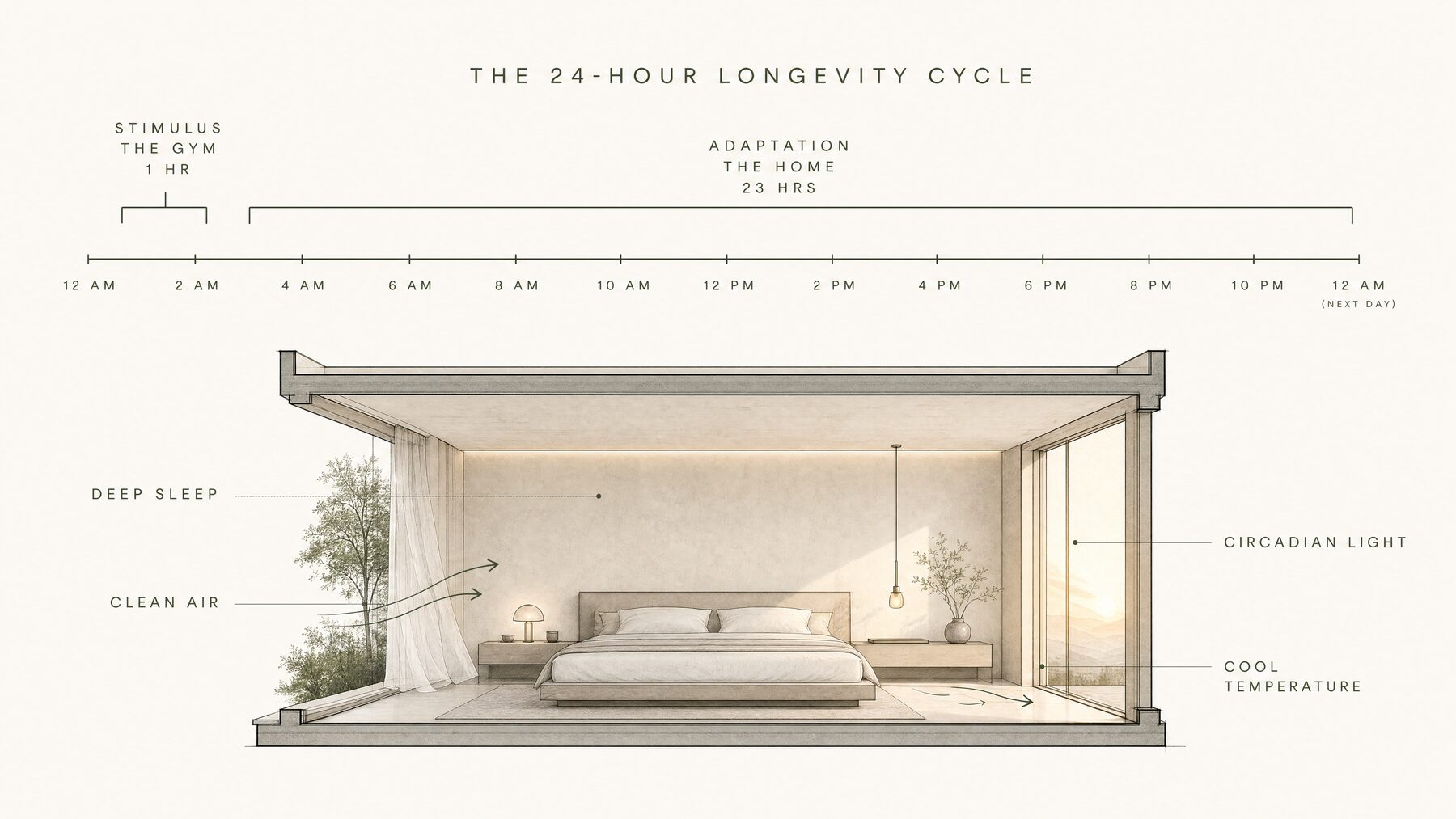
The same discipline Attia brings to programming a training block applies to the place recovery happens. A bedroom can be specified as deliberately as a workout: MERV-13 filtered air, an acoustic floor low enough for uninterrupted deep sleep, light that dims into a warm colour temperature through the evening, a thermal setpoint cool enough to let the body shed heat overnight, materials that are not off-gassing into the room you breathe in for eight hours. This is the recovery envelope. It is engineering, not decoration, and it is where the marginal decade is actually banked.
Train the room too
MAVI applies the discipline Attia brings to the gym to the place the body recovers. Ten domains, one hundred and twenty-nine measurable factors, the air, temperature, light and sound of the home tuned so the twenty-three hours protect the one. Get the exercise house in order. Then get the actual house in order.
What to do now
Treat the bedroom as recovery equipment, specified as deliberately as a training block:
- Temperature
- 16 to 19 °C
- Air (CO₂)
- < 800 ppm overnight
- Sound
- < 30 dBA at night
- Light
- Blackout, < 2700K evening
- Measure it. A free MAVI Snapshot scores your recovery envelope; the Diagnostic reads all ten domains.
- Temperature. 16 to 19°C, so deep sleep, growth-hormone release and tissue repair complete.
- Air. MERV-13 filtration, PM2.5 under 5 µg/m³, overnight CO₂ under about 800 ppm, so recovery breaths are not doing extra work.
- Sound. A night-time floor under about 30 dBA, the WHO guideline, so the nervous system fully stands down.
- Light. Blackout to sleep in, warm and dim under about 2700K through the evening, bright daylight on waking.
- Materials. Low-VOC finishes in the room you breathe in for eight hours.
Same protocol, better room, and more of the adaptation you trained for actually sticks.
The single sentence
Attia builds the fitness in the gym. MAVI keeps the home from spending it overnight.
This essay responds to Dr. Peter Attia and Dr. Andrew Huberman on exercise and longevity, read through the MAVI lens. Generate a free Snapshot of your home.