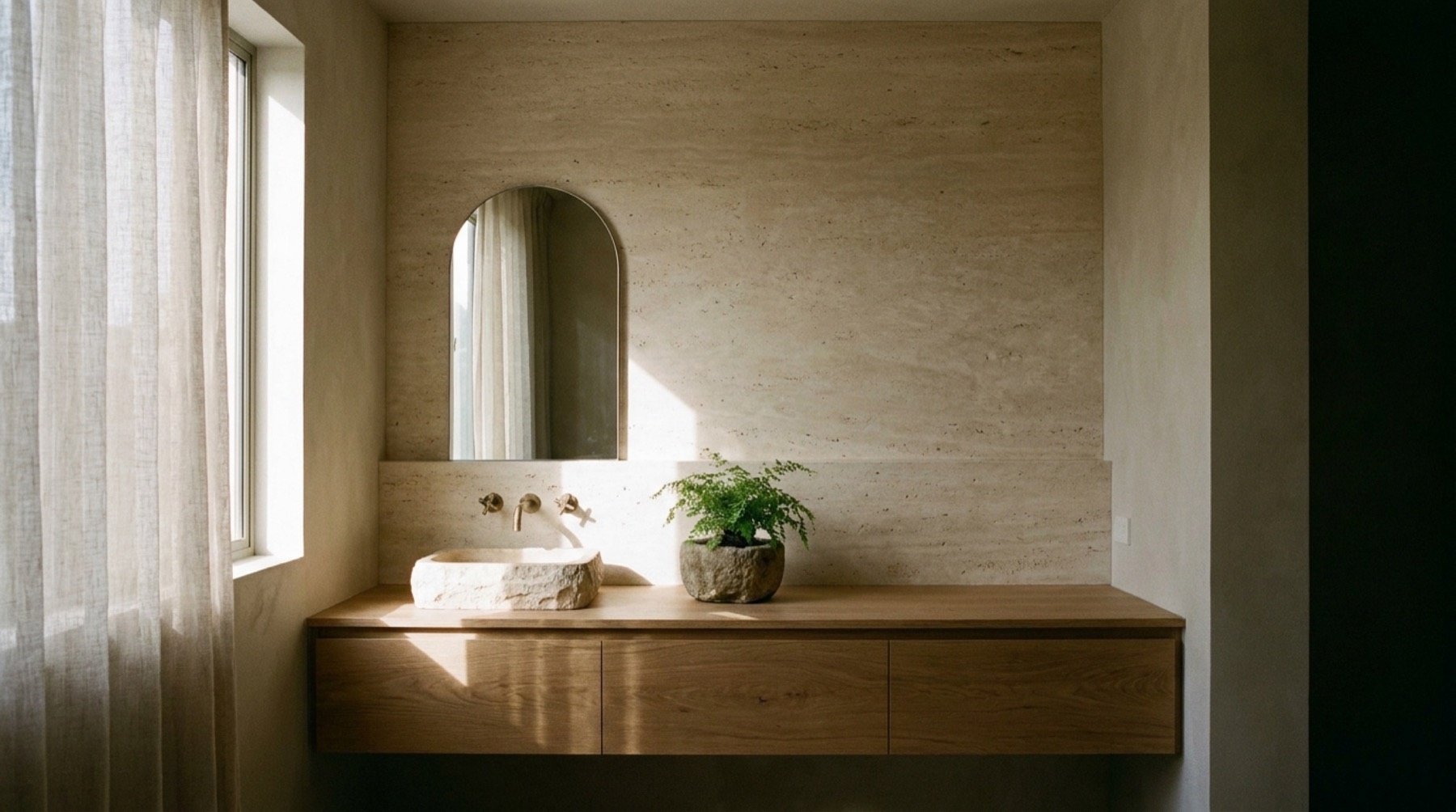
A guest steps into a beautifully designed room. Within a few minutes, their nervous system tells them whether the room is calm. They cannot say why. We can.
The vocabulary of stillness is biological
Designers tend to talk about stillness as a property of light, proportion, palette, and texture. These do contribute. But the most consequential layer of stillness is one no eye can see: the chemical signature of every surface exhaling into the air the body breathes for the next eight hours.
A chemically silent room is one in which the formaldehyde from MDF substrates, the toluene from oil-based finishes, the phthalates from softened PVC, and the perfluorinated alkyl substances from stain-resistant textiles are not in the air. The body, which has receptors tuned to these compounds across forty million years of evolution, can rest.
What off-gasses, what stops
Every interior assembly off-gasses on a curve. The most aggressive period is the first twenty-eight days; meaningful release continues for two to five years; some compounds (heavy phthalates, certain PFAS) continue at a low rate for the life of the material. The naive approach, open the windows for a week before move-in, addresses 5% of the problem.
The disciplined approach is upstream:
- Substrates: solid timber, cross-laminated panels with formaldehyde-free adhesives, mineral boards. Avoid MDF, particleboard, and any panel substrate with a urea-formaldehyde glue spec.
- Finishes: water-based coatings with VOC content under 50g/L, solvent-free oils for natural finishes. Avoid all oil-based polyurethanes.
- Adhesives: structural adhesives certified to GREENGUARD Gold or AgBB. Avoid generic construction adhesives.
- Soft furnishings: untreated natural fibres (linen, hemp, organic cotton, wool). Avoid stain-resistant treatments without explicit PFAS-free certification.
- Stone, grout, sealant: dry-set tiles with epoxy-free grout. Sealants based on silicon rather than urethane chemistry.
None of these substitutions affects the visible aesthetic. All of them affect the chemical signature of the room.
The unseen luxury
This is the unseen luxury. A room can read as quiet, calm, and still without the visitor knowing why. The eyes register no difference; the receptors register a substantial one. The body’s sympathetic-nervous baseline drops measurably within minutes of entry into a chemically silent space. Within a fortnight of full-time residence, the cumulative reduction in inflammatory load is detectable on lab work.
The forgotten domain
Of the ten MAVI 129™ domains, Materials is the most often overlooked in luxury residential. Air systems get the budget. Lighting gets the budget. Sound gets the budget. Materials are typically chosen against a sample-board, not against a chemical specification.
This is the easiest leverage in the framework. The substitutions cost a small premium. The biological return is large. The room reads, to anyone who walks into it, as calmer, without anyone being able to articulate why.
The new vocabulary
We are moving into a period in which residential specification will be discussed in two languages, the language of design (palette, proportion, light) and the language of chemistry (off-gassing, VOC, PFAS, microplastic load). The houses that read as the calmest will be the houses fluent in both.