
In his conversation on The Diary of a CEO, David Sinclair) lays out the information theory of ageing. A cell does not wear out like a tyre. It keeps the full original DNA and slowly loses the instructions for reading it, the way a disc keeps its music while the scratches make it unplayable. In his lab, partial epigenetic reprogramming reset that read-out, and he reports skin and tissue that, on the markers measured, looked dramatically younger. Ageing, in his frame, is lost information. And information, unlike a worn part, can be restored.
It is a genuinely hopeful idea, and we want to sit with it properly before turning it on its head. So start with the source.
Watch it to the end and you will hear a complete theory of why we age and a credible path to slowing or reversing it. You will not hear a single sentence about the room the patient goes home to. That silence is the subject of this essay.
Ageing as forgetting
Sinclair's argument rests on a distinction most longevity talk blurs: the difference between the genome and the epigenome. The genome is the hardware, the fixed sequence of letters you were born with. The epigenome is the software, the set of switches that decides which genes are read in which cell, at which moment. A liver cell and a neuron carry identical DNA; what makes one a liver and the other a brain is the epigenetic read-out. His claim is that ageing is the slow scrambling of that read-out. The cell suffers what he calls an identity crisis. It still has the score; it forgets how to play it.
The repair machinery at the centre of this is a family of enzymes called sirtuins, and they run on a molecule called NAD+. Two things happen with age. NAD+ falls. And the sirtuins, which should spend their time regulating which genes are expressed, get pulled away to deal with an accumulating backlog of DNA damage. Every break, every insult, is a distraction. The more damage arrives, the less attention is left for keeping the read-out clean, and the faster the cell forgets.
NAD+ levels and sirtuin availability decline through adult life, so the machinery that keeps the epigenetic read-out clean has less to work with. Directional, after Sinclair.
The reset is real, and it is incomplete
The headline experiments are extraordinary. Using three of the four Yamanaka factors, Sinclair's team has reset the epigenetic age of cells without erasing their identity, restoring sight in mice by rejuvenating optic-nerve cells and pointing toward human trials. The promise is that we will one day reinstall the lost software on demand.
But a reset is a moment, and ageing is a process. Reprogram a cell today and it wakes up tomorrow in the same body, in the same bed, in the same room, with the same stream of damage arriving. The therapy addresses the symptom of forgotten information. It does nothing about the cause of the forgetting. The more aggressive the reset, the more it matters what you are resetting the cell back into.
What scratches the disc
The part worth holding onto is not the reset. It is the cause. The read-out degrades because the cell lives under a constant barrage: oxidative stress, inflammation, particulate, the steady drip of environmental insult. Each one creates work. Each piece of work pulls the repair machinery further from its real job. So the honest question is not only how to reinstall the software once it is corrupted. It is what keeps writing the corruption, night after night, for decades.
Sinclair optimises that picture from the inside. He fasts, he takes molecules that support NAD+, he is candid about the protocol he runs. All of it is aimed at giving the cell more capacity to repair. None of it changes the rate at which damage is delivered. And the largest, most relentless delivery system is not in a syringe or on a plate. It is the building.
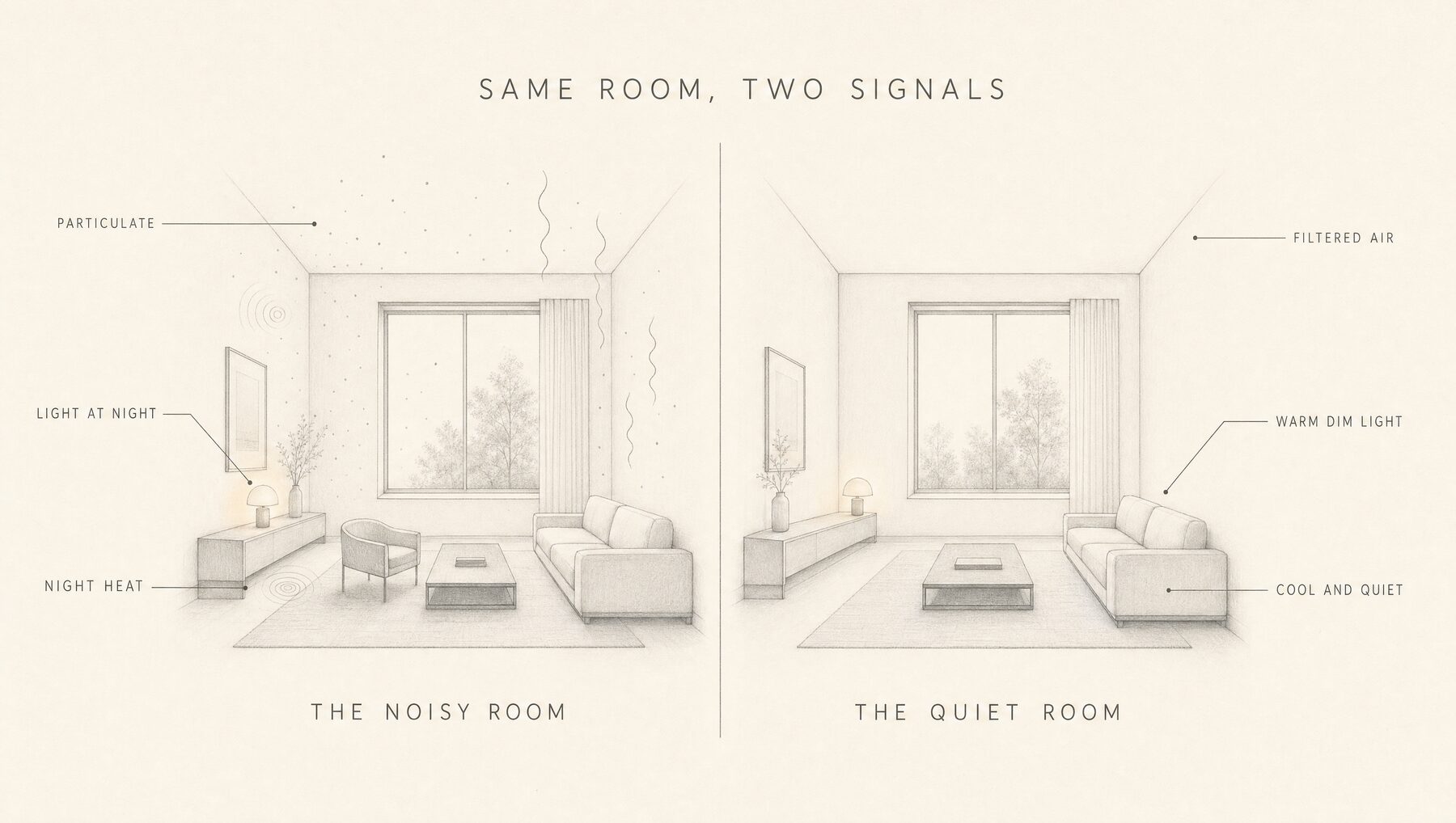
The largest source of the noise
Consider what runs around the clock in an ordinary room. Air carrying fine particulate and combustion by-products, drawn into the lungs and the bloodstream breath after breath. Light at the wrong hour, telling the body it is noon at midnight and blunting the hormonal repair that is supposed to happen in the dark. Heat the bedroom never sheds, so sleep stays shallow and the nightly clear-out never completes. Sound that keeps the nervous system half-braced. Materials off-gassing into a sealed space.
This is not occasional stress. It is the steady static of the environment, applied for the roughly one hundred and sixty hours a week the average person spends indoors. It is also the one variable the entire longevity conversation walks straight past. The protocol optimises the body. The room keeps reminding the cell of exactly the damage the protocol is trying to undo.
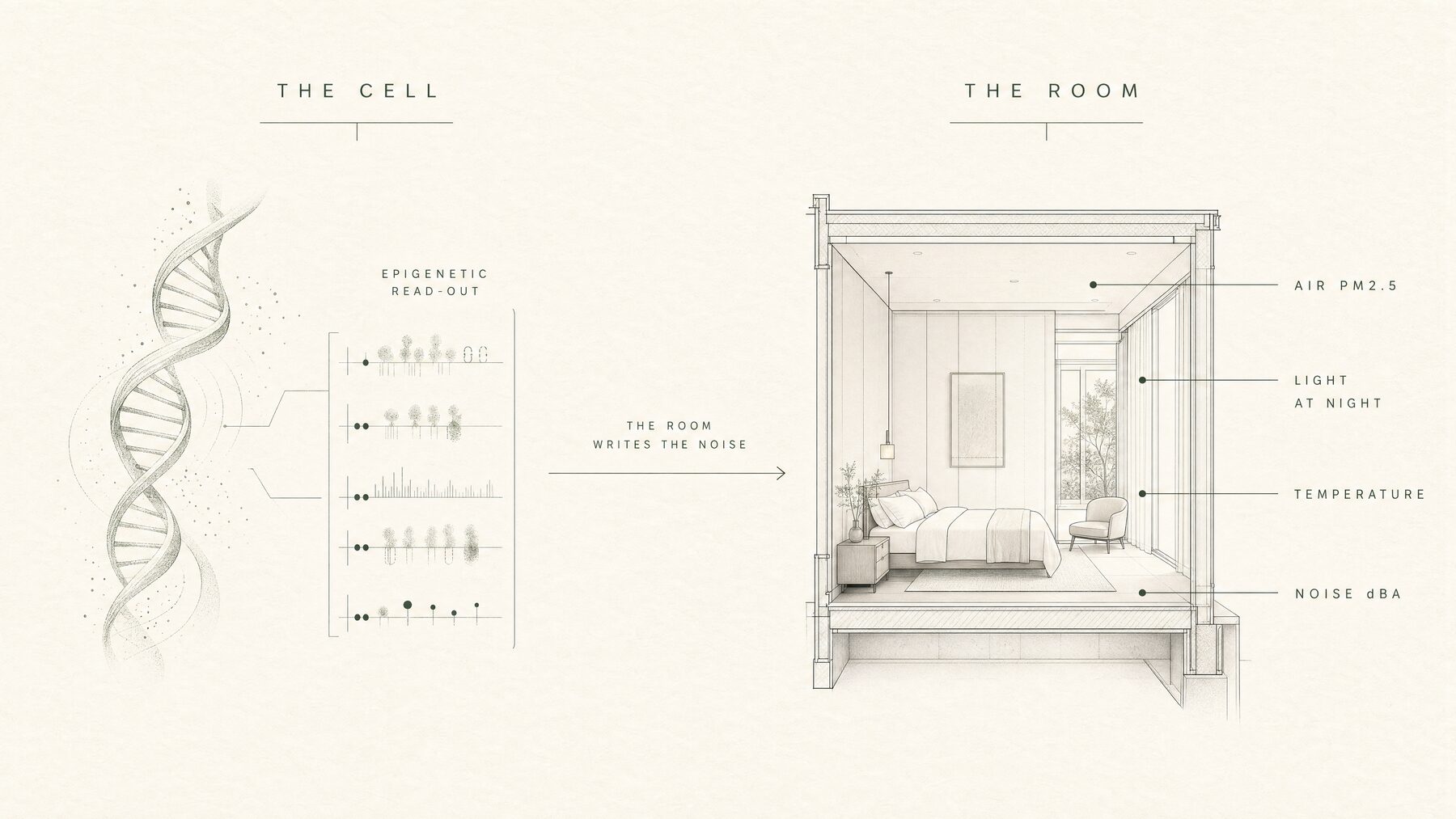
The room, read domain by domain
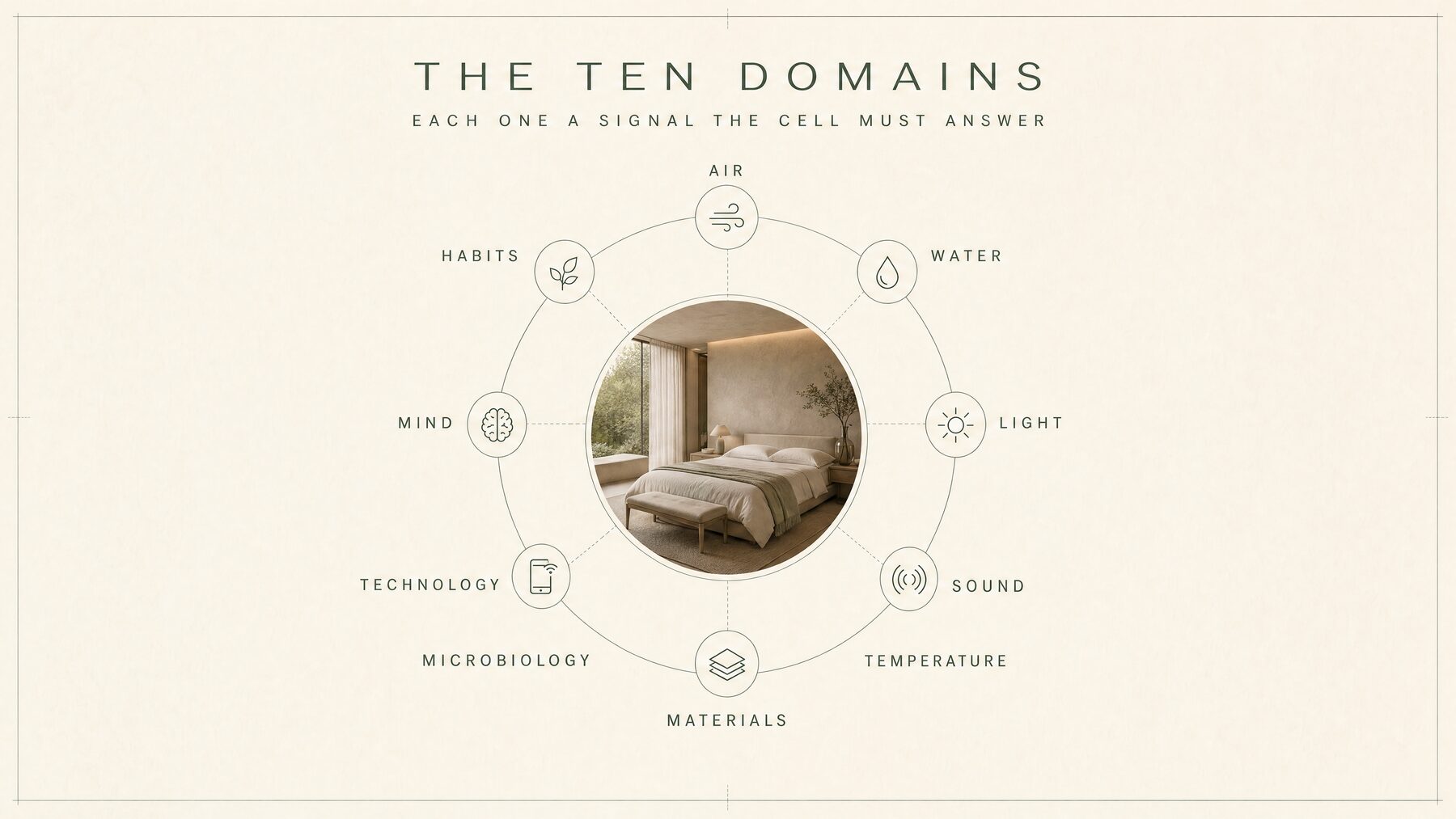
The reason the building is so easy to ignore is that it presents as a single thing: home. Pull it apart and it becomes a set of measurable inputs, each one a distinct source of cellular load. Air. Water. Light. Sound. Temperature. Materials. Microbiology. Technology. Mind. Habits. Ten domains, each one either adding to the noise or subtracting from it, depending entirely on how the space was specified.
Take just three. Air: fine particulate and volatile compounds drive the oxidative stress and inflammation that keep sirtuins busy with repair instead of regulation. Light: a bright screen at midnight suppresses the melatonin that gates a whole programme of overnight cellular maintenance. Temperature: a bedroom that cannot shed heat fragments the deep sleep during which much of that maintenance is scheduled. None of these is exotic. All of them are specifiable. And all of them are running tonight, in most homes, unmeasured.
That is the shift MAVI makes. Not a wellness mood, but a reading. Each domain decomposes into measurable factors, one hundred and twenty-nine of them in total, every one graded against published thresholds and weighted by how much of your life is exposed to it. The point is not to chase a perfect number. The point is to stop a home from being an uncounted, unmanaged source of the precise stress Sinclair is racing to reverse.
Specify the input, protect the information
MAVI works on that input. We read a home across the ten domains and the one hundred and twenty-nine measurable factors, then specify the air, light, temperature, sound and materials so the environment stops adding to the load. This is not a treatment for the cell. It is a quieter room for the cell to keep its memory in.
Think of it as the order of operations. A reset that one day reinstalls what was forgotten will still be handed back, every night, to whatever environment the patient sleeps in. If that environment is loud, the read-out starts degrading again the moment the therapy wears off. If it is quiet, the gains hold for longer and the body spends less of itself simply coping. The cheapest, most durable longevity intervention available today is not a molecule. It is to stop scratching the disc in the first place.
What to do now
The fastest way to slow the forgetting is to lower the load the cell has to answer to. In order of return:
- Air
- PM2.5 < 5 µg/m³
- Light
- < 2700K after dark
- Temperature
- 16 to 19 °C
- Materials
- Low-VOC finishes
- Measure it. A free MAVI Snapshot reads your address across eight live data sources; the Diagnostic scores all ten domains and the full 129.
- Air. Target fine particulate (PM2.5) under 5 µg/m³ and bedroom CO₂ under about 800 ppm overnight, with MERV-13 filtration and real ventilation. Particulate and stale air are continuous oxidative and inflammatory load, the exact distraction that pulls repair enzymes off the read-out.
- Light. True darkness to sleep in, warm light under about 2700K and low intensity for the last two hours of the day, bright daylight on waking. This protects the melatonin-gated overnight maintenance.
- Temperature. Hold the bedroom around 16 to 19°C so deep sleep, and the repair scheduled inside it, can complete.
- Materials. Low-VOC finishes and furnishings; let anything new off-gas before it shares your air.
Each one is a source of noise removed, so the machinery can spend its time keeping the read-out clean instead of fighting the room.
The single sentence
Sinclair is restoring the information inside the cell. MAVI removes the noise in the room that keeps erasing it.
This essay responds to David Sinclair on The Diary of a CEO, read through the MAVI lens. Generate a free Snapshot of your home.