The wellness suite is, in most luxury residences, the single most chemically loaded room in the house. Chlorinated pool water, vinyl-and-rubber matting, strong cleaning protocols on stone and grout, generous off-gassing from sauna timber treatments, condensation cycling moisture between surfaces. The room is anti-microbial in chemistry, and, by exact consequence, biologically depleted in a way the immune system reads as unfamiliar.
It is, on its own terms, a hospital room with sauna fittings.
What an immune system actually wants
The human immune system has, across two hundred thousand years, calibrated itself against a specific microbial environment: a moderately diverse, moderately abundant native microbiome of the surfaces we live on. Over-sterilisation, particularly in the developed world, is now a leading hypothesis for the rise in autoimmune and allergic conditions across the last fifty years (the hygiene and biodiversity hypotheses).
A correctly designed wellness suite does not bleach itself. It maintains a deliberate microbiome, diverse, low-pathogen, biologically appropriate.
How the suite is specified
A MAVI-specified wellness suite handles microbiology as a designed parameter, not as a battle:
- Sauna timber: untreated thermally-modified aspen or alder. No chemical fungicide. Heat-cycle is sufficient sterilisation.
- Steam room: sealed stone (Travertine, slate) with non-chlorinated periodic cleaning. Drainage that prevents standing water; ventilation that returns the room to ambient humidity within twenty minutes of use.
- Pool water: UV plus ozone treatment with minimal residual chlorine. Salt-electrolysis for the residual; pH held at 7.2–7.6.
- Cleaning protocols: quaternary-ammonium and sodium hypochlorite restricted to single-monthly deep clean. Daily protocol: warm water plus saponins. The native microbiome stays alive.
- Air system: dedicated wellness-suite ventilation with HEPA-13 supply, separate from the residence’s main air system. Compounds from sauna and pool are not recirculated into the bedrooms.
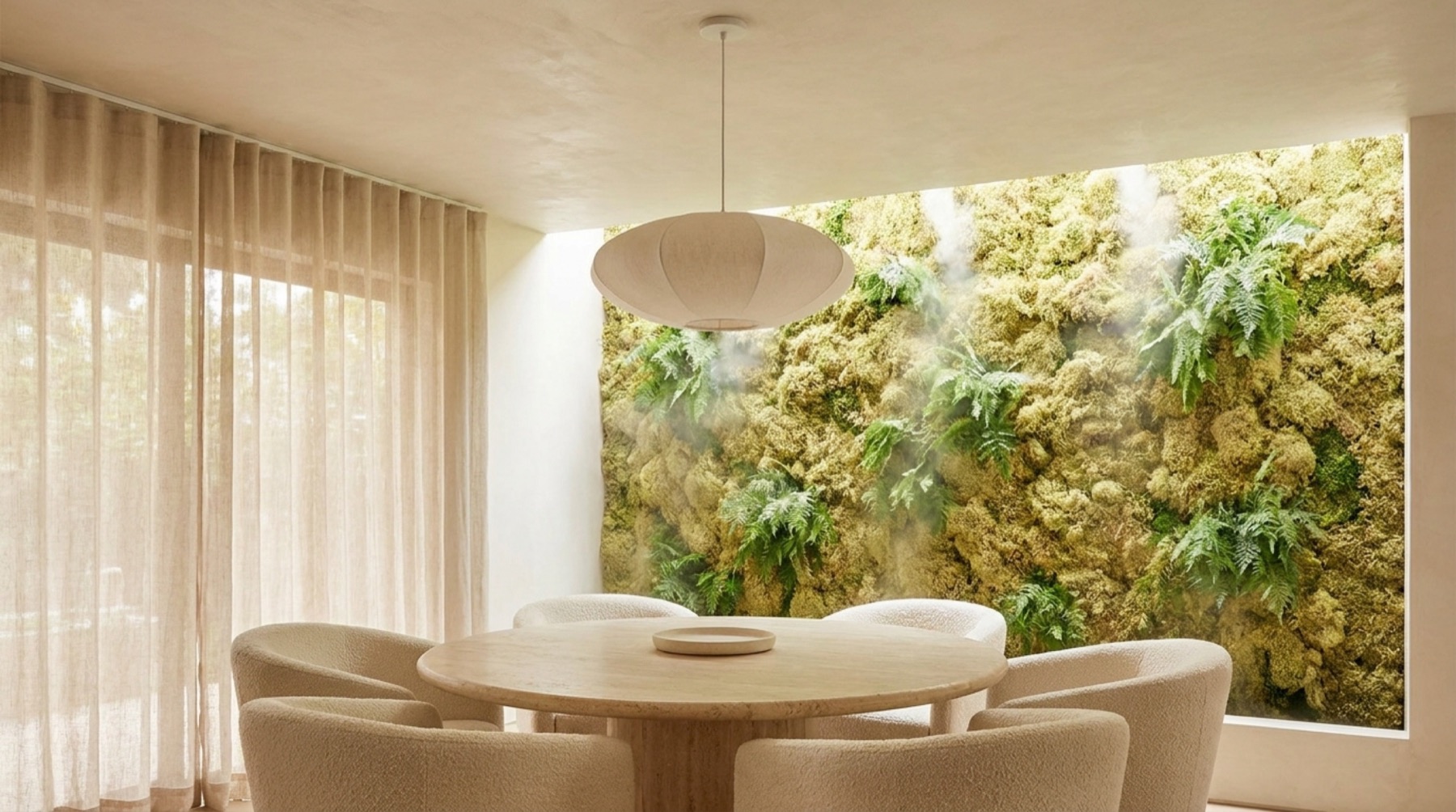
- Plant integration: living wall in the recovery area with a deliberately diverse range of species. The transpiration provides humidification, the leaf surfaces host beneficial bacteria, the roots are biofiltering trace VOCs from the suite.
The biological return
Within a fortnight of moving from a chemically-loaded wellness suite to a microbiologically-balanced one, an unmistakable change occurs in the body’s response to the room. The post-sauna recovery feels different, less drained, more energised. The skin’s response to the suite is calmer; the eye’s response to the steam room is gentler; the respiratory tract’s recovery from the sauna is faster.
The cumulative effect, over the years of a residence, is a more diverse, more robust immune calibration, a body that responds proportionately to ambient pathogens rather than over-reacting to small exposures or under-reacting to genuine threats.
The harder lesson
The harder lesson, for the luxury market, is that cleanliness and health are not the same parameter. A surgical-clean wellness suite is biologically poor for the body that uses it. The aesthetic of spotless, the chrome handle, the bleached grout line, the freshly chlorinated pool, is, on the immune system’s terms, the wrong target. The aesthetic worth pursuing is balanced: clean to the eye, biologically alive to the body.
We expect that, within a decade, microbiological balance will be a routine specification parameter for residential wellness suites, the way water filtration is now becoming routine. Until then, this is one of the easiest, most durable, most biologically meaningful upgrades available in the framework.