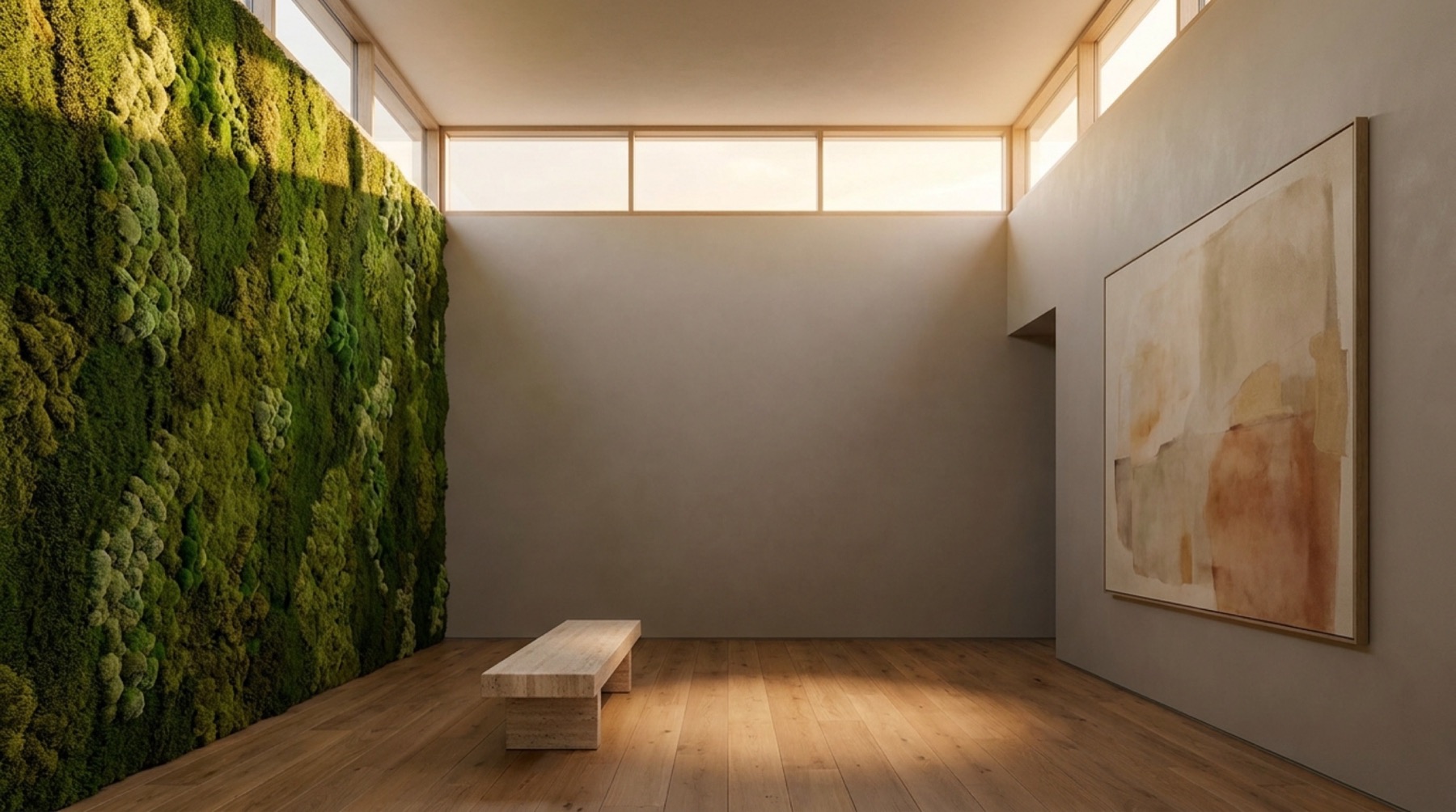
If you wanted to design a lighting scheme that broke a person’s biological clock, you would specify exactly what most luxury homes already specify.
The problem with good lighting
The luxury market has converged on a lighting language: 2700K to 3000K, dimmable, soft, generous on the face. This language is genuinely beautiful. It is also, biologically, a problem.
Suprachiasmatic nucleus signalling, the master circadian regulator, runs primarily on melanopic illuminance, not photopic. Melanopic-equivalent daylight illuminance (mEDI) at the eye is the scientifically meaningful number. At noon, on a sunny day, you receive 10,000+ mEDI lux at the eye. After sunset, with a single 60W warm bulb at three metres, you receive perhaps 5 mEDI lux.
The body has, for two hundred thousand years, used these two numbers as the most reliable signal of what time it is. A luxury home that holds a steady 50–80 mEDI lux from 9am to 11pm is, biologically, holding a steady mid-afternoon for fourteen hours. The body’s clock has nothing to entrain to.
The right shape of a day
A circadian-aligned residence has a shape of light through the day:
- Morning (5am–9am): rapid ramp from 0 to 1500+ mEDI lux at the eye. Cool, blue-rich (≥6000K). Direct overhead positioning. Architectural skylights, hopper windows, cool-spectrum LED supplementation when the sun is below threshold.
- Midday (9am–4pm): steady 800–2500 mEDI lux. 4000–5000K. The brightest, coolest period of the day, mirroring noon sun.
- Late afternoon (4pm–7pm): gentle decline to 200–400 mEDI lux. Warming spectrum, 3500K to 3000K.
- Evening (7pm–10pm): warm, low. Under 50 mEDI lux. 2700K or lower.
- Late evening (10pm–sleep): under 5 mEDI lux. 1900K candles, amber-only fixtures, no overhead. The bedroom transitions to 0.5 lux ambient by lights-out.
- Night (sleep): 0 lux. No standby LEDs visible. Even a 1-lux bedside clock measurably suppresses melatonin.
Most luxury homes get the evening register correct, and nothing else. The bigger gains are upstream, in the morning and at noon.
What changes when light is right
The changes are not subtle. Within a fortnight of full-time residence in a circadian-aligned home:
- Sleep onset latency drops by an average of 18 minutes.
- Morning cortisol rises more sharply and falls earlier in the day.
- Mood and cognitive variability across the day flatten.
- Wearable HRV during sleep increases by a measurable amount.
These are not aesthetic claims. They are the recorded effects of an established intervention, restoring a biological signal that civilisation has drowned out.
The architecture of the morning
The most underspecified architectural element in luxury residential is the morning. The bedroom typically faces a quiet aspect; light is filtered, cool, generous on the eye. This is correct only for the lights-out hour. For the lights-on hour, a bedroom needs aggressive cool light at the eye for fifteen minutes, and very few luxury bedrooms are designed for it.
A correctly specified residence has a morning programme:
- Skylight or high-clerestory east-aspect window in the bedroom or its immediate adjoining room.
- A 6500K, 1000+ mEDI lux supplementation fixture above the bed, on a thirty-minute morning ramp.
- A dawn-simulation alarm built into the room’s lighting control rather than a bedside device.
The body wakes. The clock resets. The day begins.
The lighting designer’s new mandate
Lighting designers will, within the next five years, need to expand their vocabulary from photopic (lux on the surface, K of the source) to melanopic (mEDI lux at the eye, throughout the day, room-by-room). The tools exist. The standards exist (the WELL Building Standard’s circadian-design credit, CIE S 026/E:2018). What is missing is the mandate, and that is what MAVI provides.
A final note
The most luxurious thing a home can deliver is the quiet recovery of a body that has, for the first time in a long time, been allowed to know what time of day it is.