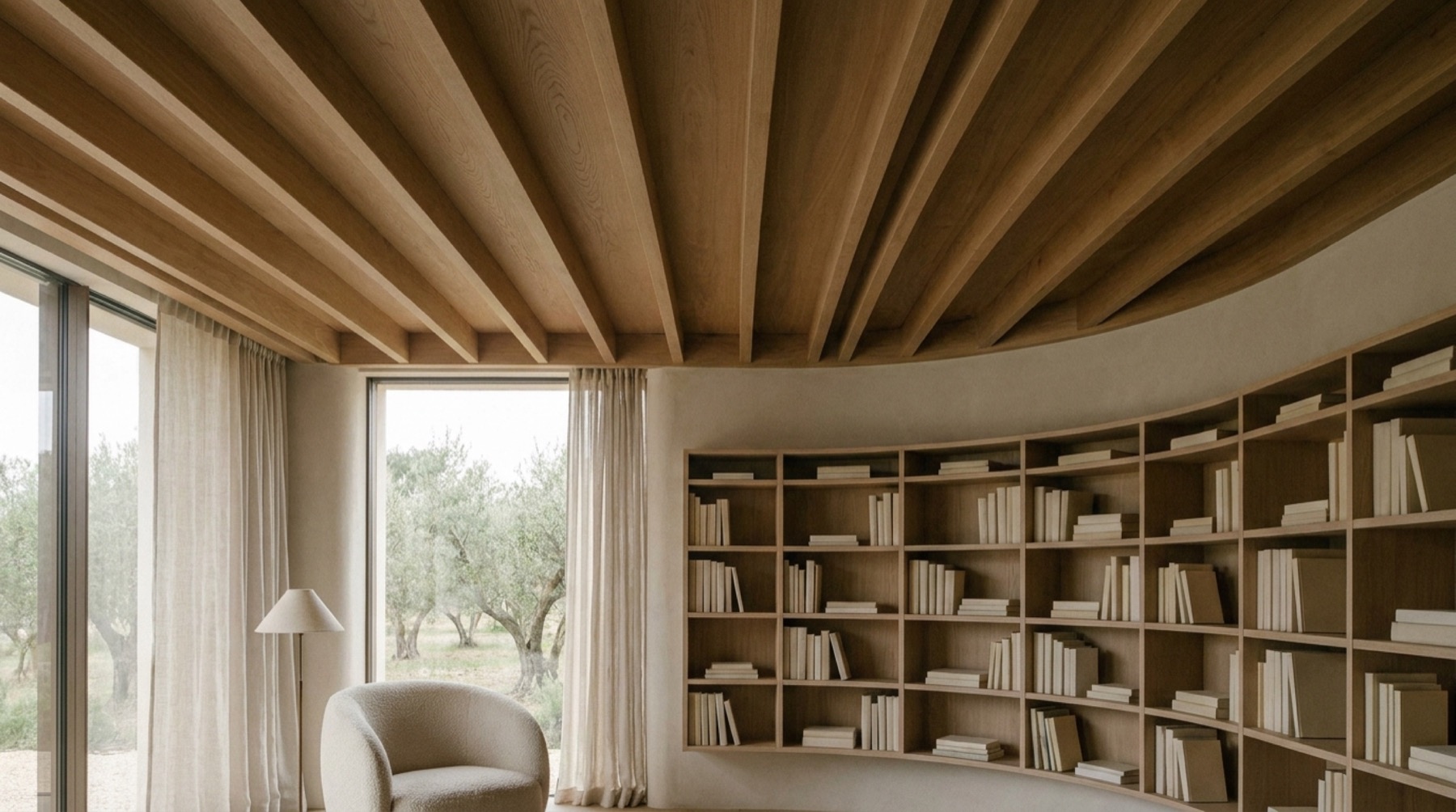
The biophilia conversation has, for a decade, focused on the wrong unit. The literature does not say more plants are better. It says the right framing of the right element is better. The unit of work is the view-cone from the seated or standing position, not the count of houseplants on the shelf.
What the eye actually does
The visual cortex performs threat-and-resource evaluation continuously. In an interior containing thirty houseplants, the cortex evaluates each one, is this thriving? is this in distress? is this the right shape?, and the cumulative cognitive load is non-trivial.
In an interior containing a single, mature tree, framed by a correctly proportioned window, at the focal point of a room, the cortex’s response is different. The single, healthy organism reads as stable resource; threat evaluation drops; parasympathetic activity increases; blood pressure measurably decreases.
The Roger Ulrich studies in the 1980s, the foundational papers in this literature, demonstrated this effect from a hospital window onto a single tree, against the same window onto a brick wall. The recovery time of post-surgical patients differed by an order of magnitude. It was not the quantity of nature; it was the framing.
The view-cone as a design unit
A correctly designed interior treats each major sitting or standing position as a view-cone problem. Each cone, from each position, should contain at least one biophilic anchor: a window onto a single mature tree; a sculptural plant of architectural quality; a fireplace; a body of water; a long-distance view; a textile with a natural pattern. The cones should not contain visual clutter, threat-shaped objects, or competing biophilic elements that fragment the attention.
This is a discipline of editing, not adding.
What works
The biophilic elements that consistently lower sympathetic-nervous activation in the literature are:
- Mature, single-organism plants. A large Strelitzia, a mature olive tree, a sculpturally pruned ficus. Quality, scale, and posture matter.
- Long-distance views to a horizon. Particularly powerful: water, mountains, an open meadow. The prospect-refuge response is hard-wired.
- Fire. A real wood-burning fireplace, where regulation permits, or a high-quality bioethanol fire of generous proportions. The flicker frequency interacts with limbic signalling; the effect is consistent across cultures.
- Water. A still pool, a quiet fountain, a reflecting plane. Sound under 35 dBA; movement under 0.5 m/s.
- Natural materials at scale. A single solid-timber wall; a Travertine fireplace; a generous sheepskin or linen drape. Not in fragments, not in competition.
What does not work
The most common biophilic mistakes in luxury residential:
- Quantity without quality. Twelve undersized houseplants signal threat to plant health more than they signal abundance. The body reads the distress.
- Mixed nature signals. A reef tank in the same view-cone as a desert succulent and a tropical orchid. The cortex evaluates each separately.
- Fragmented natural materials. Travertine in random patches across a marble floor. The eye cannot resolve the surface to a whole.
- Real plants in artificial light. The visual cortex registers the colour-temperature mismatch; the parasympathetic effect inverts.
The role of the window
The single most powerful biophilic element in any residence is the window. Every major sitting position should have, in its primary view-cone, at least one window onto a biophilic anchor, a tree, a horizon, a water surface, a sky. Every bedroom should have a primary window onto a non-residential view. Every dining position should have a window with a long-distance vector.
If the building does not provide these windows, the architect’s brief is to find them, clerestory, light-well, internal courtyard, a borrowed view across the street, a periscoped sky-view. Biophilia is the most expensive item to retrofit and the cheapest item to design in.
A discipline of attention
The word biophilia has, in the last few years, become an aesthetic adjective, slid into mood-boards alongside organic, raw, earthy. The biological discipline behind it has nothing to do with mood-boarding. It is about attention: where the eye lands, what the cortex evaluates, what the body, in a microsecond before consciousness, decides about its surroundings. A correctly designed residence directs that attention. The body, in turn, settles.